


What We Covered at The Business Show London 2026
Edited by the Juice editorial team. Last updated: November 2026.
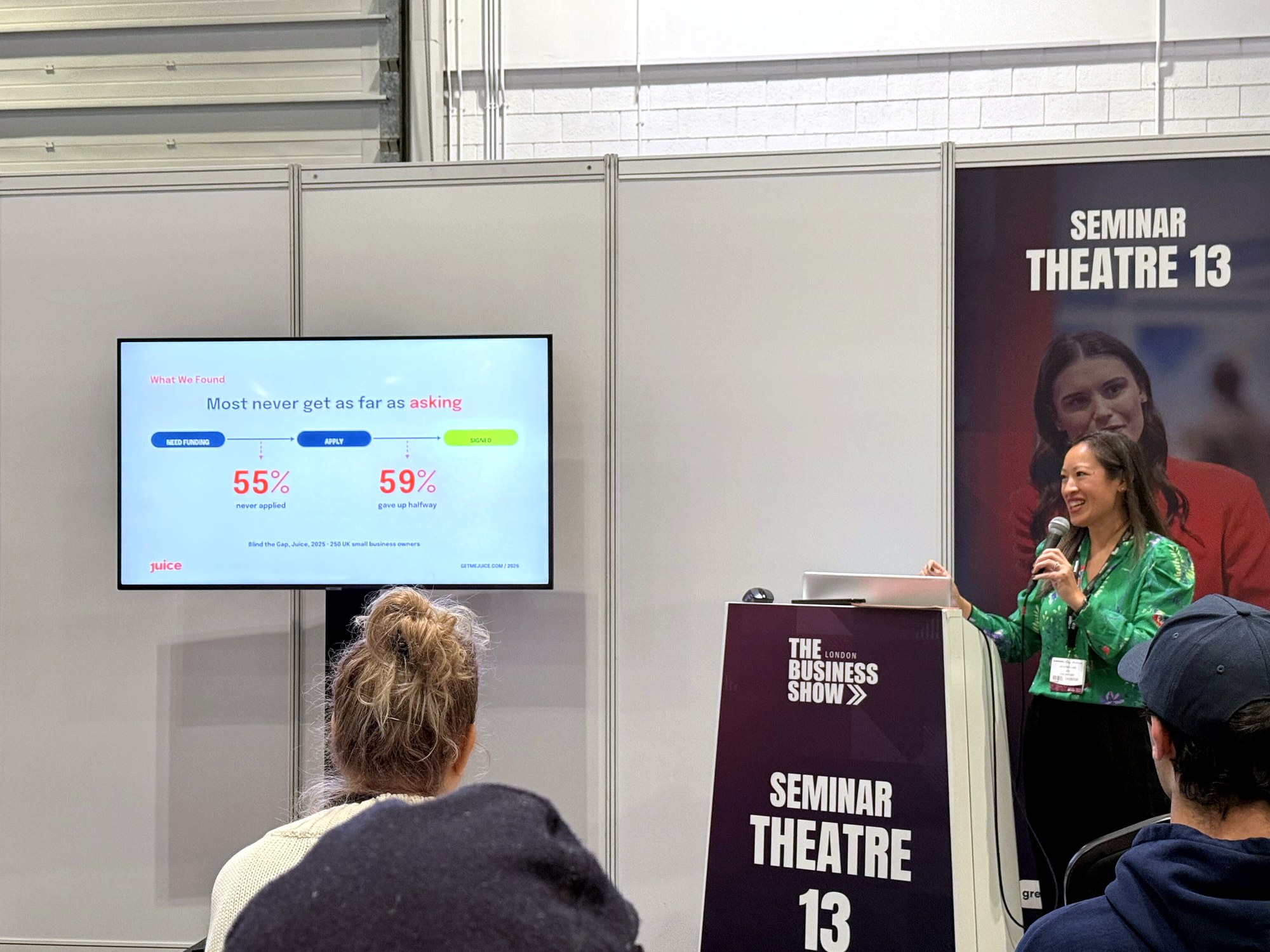
We spent 11 and 12 November at ExCeL for The Business Show London, on stand B1361. On the second day our CEO, Katherine Chan, took the stage to talk through 10 things to know before taking out a business loan.
Here is what she covered, for anyone who missed it.

Before the show
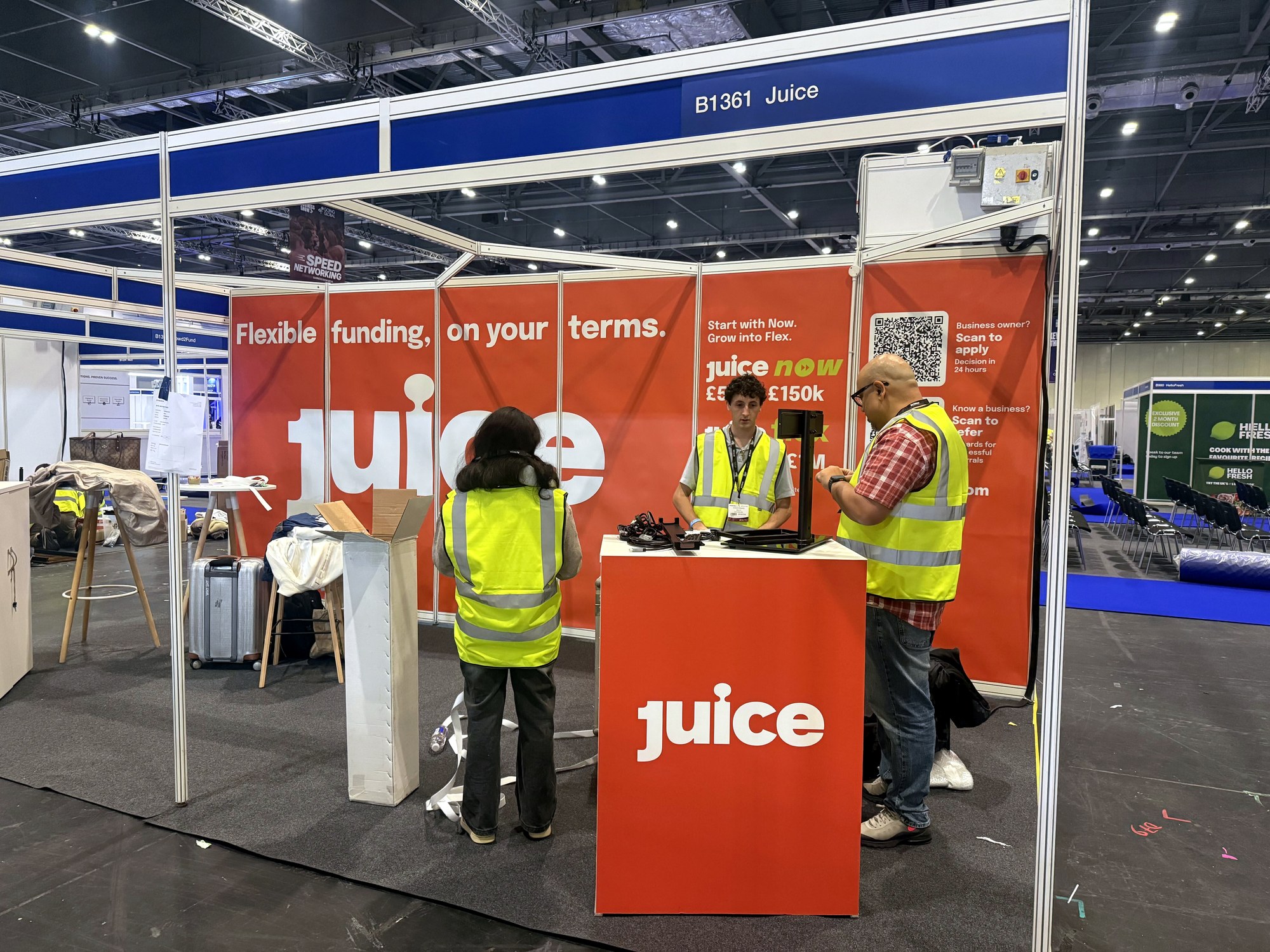
The stand went up on Tuesday 10 November, the build-up day before the doors opened, which meant an afternoon at ExCeL in hi-vis vests fixing graphics to the back wall and working out where the extension leads were going. The merch and the printed graphics had been sitting in the office for a week and came over with us on the day.
B1361 ended up as an orange back wall reading "Flexible funding, on your terms.", with 2 touchscreens on branded cupboards and the laptops hidden inside.
The touchscreens took the most thought. We built a small site just for the show and put 3 things on it: a set of borrowing games, a free business insights report with a funding readiness score, and the download for Business Borrowing 101, the guide behind Katherine's session. Anyone could walk up, pick up a screen and get something out of it in under a minute, whether or not they wanted to talk to us about funding.
The rest was the unglamorous part of exhibiting, so there were pens, notepads, caps, cups with straws, golf tees, t-shirts with a QR code printed on them, around 500 A5 flyers, and a printed checklist of what to look at before signing a funding agreement.

Where the talk came from
In 2025 we surveyed 250 UK founders for our Blind the Gap research, and 3 findings shaped the session.
- 55% of founders who needed funding never applied for it.
- 59% started an application and gave up partway through.
- 23% signed a loan agreement they did not fully understand.
(Juice survey of 250 UK SME founders, October 2025.)
Those figures describe a market where the hardest part of borrowing happens before anyone fills in a form, because businesses talk themselves out of asking, or reach the paperwork and lose confidence in what they are looking at.

The 10 things
- Borrowing isn't failing
- Test it on your quietest month
- Borrow while things are calm
- The right tool for the job
- Your bank isn't the only door
- The rate is only the headline
- A guarantee makes it personal
- Who's first in the queue?
- Read past the first page
- No question is too basic
Borrowing isn't failing
Only 27% of the founders we surveyed described debt as a strategic tool, while 64% of businesses under 5 years old had put growth plans on hold because they could not access finance.
Borrowing gets treated as an admission that something has gone wrong, so the conversation gets delayed until something has, which is the worst moment to be asking. Deciding whether to borrow is easier while there is still time to choose.
Test it on your quietest month
The affordability test Katherine gave the room needs no spreadsheet. Look back through 6 to 12 months of bank statements and find your quietest month, then ask whether you could have made that repayment while still covering suppliers, staff, rent and tax. If the answer only works in a good month, either the repayment is too big or the timing is wrong.
The right tool for the job
A term loan is the product most people know, so it ends up being used for everything, when each kind of finance is built for a different job. The rule of thumb is to match the length of the borrowing to the life of whatever you are paying for.
A van or a machine that will last years suits asset finance, and a one-off project with a clear payback suits a term loan. Customers who take 60 days to pay suit invoice finance. Gaps that open and close across the year suit revolving credit or an overdraft. Juice Flex is a continuous line of credit that works alongside your business. Subject to status and lending criteria.
Chapter 4 of Business Borrowing 101 and our guide to the types of business finance in the UK set these out side by side.
The rate is only the headline
The lowest advertised interest rate is not reliably the cheapest borrowing, because fees and the method used to calculate the rate can make a lower headline number cost more over the life of the facility. What matters is the total cost to repay across the whole term, including everything that sits outside the rate, which is how we break down the cost of a revolving credit facility.
A guarantee makes it personal
A personal guarantee can outlast the company it was given for, and depending on how it is drafted it may still apply after the business has stopped trading. That is the detail most often missed by people signing one. If a guarantee is on the table, ask what triggers it, what it is capped at and who else has signed, and take legal advice on the wording before you sign. It sits alongside the loan terms UK founders find hardest.
Your bank isn't the only door
If a designated UK bank turns down your application, it has to offer to refer you on. Under the Small and Medium Sized Business (Finance Platforms) Regulations 2015, designated banks must offer to pass the details of a declined application to designated finance platforms, with your consent, and the British Business Bank sets out how the Bank Referral Scheme works.
Take-up is low. The Treasury's October 2025 consultation on the scheme reports that only around 2% to 3% of rejected businesses opt for a referral. If you have been turned down recently, it is worth asking the bank directly, and our piece on why the bank says no covers what tends to sit behind a decline.
It is also worth asking any broker you work with how they are paid, so you know what is shaping the options you are shown.
At the stand
Away from the stage, the borrowing games on the touchscreens did most of the work, because they gave people a reason to stop at a lender's stand who would not otherwise have stopped.
The team worked both days, on the stand and out across the floor.
The guide behind the talk
All 10 points, with the questions to ask at each stage, are in Business Borrowing 101. Chapter 3 covers getting lender-ready before you approach anyone and chapter 4 compares the main types of finance, and the wider business loans UK hub has the rest.
Katherine closed on the 10th point. In our research, 42% of business owners said they had felt uncomfortable asking a lender a basic question, and 82% wanted loan terms written in plain, jargon-free language.
(Juice survey of 250 UK SME founders, October 2025.)
No question about a funding agreement is too basic to ask, and a good lender expects the questions.
Thanks to everyone who came by B1361 over the 2 days, and to everyone who sat in on the session.