


Test Yourself: Should Your Business Borrow? A 3-Check Test For UK SME Owners
This is part of our business loans in the UK guide. We cover the major business financing options, what lenders look for and how to compare business finance offers.
Should your business borrow? This is a 3-part test. What is the money for and does it generate or save more than it costs? Can you make the repayment in your slowest month of the year? Have you looked for other ways to get the money? If you can confidently answer all 3 questions, you should start comparing lenders. If not, you should probably wait.
It may seem obvious, but it is easy to skip. After you've decided your business needs funding, the focus becomes lenders, rates and how quickly you can get a decision and the should we borrow question gets overlooked. Debt can be beneficial to a business. For example, a business may take on debt to fund the purchase of inventory to be ready for the upcoming busy season. Also, a business may borrow to take on a contract to perform work for a client that pays after the work is done. Debt can mask a problem, and the 3 questions below are a way to identify if you are doing this.
Is it normal to feel unsure about borrowing?
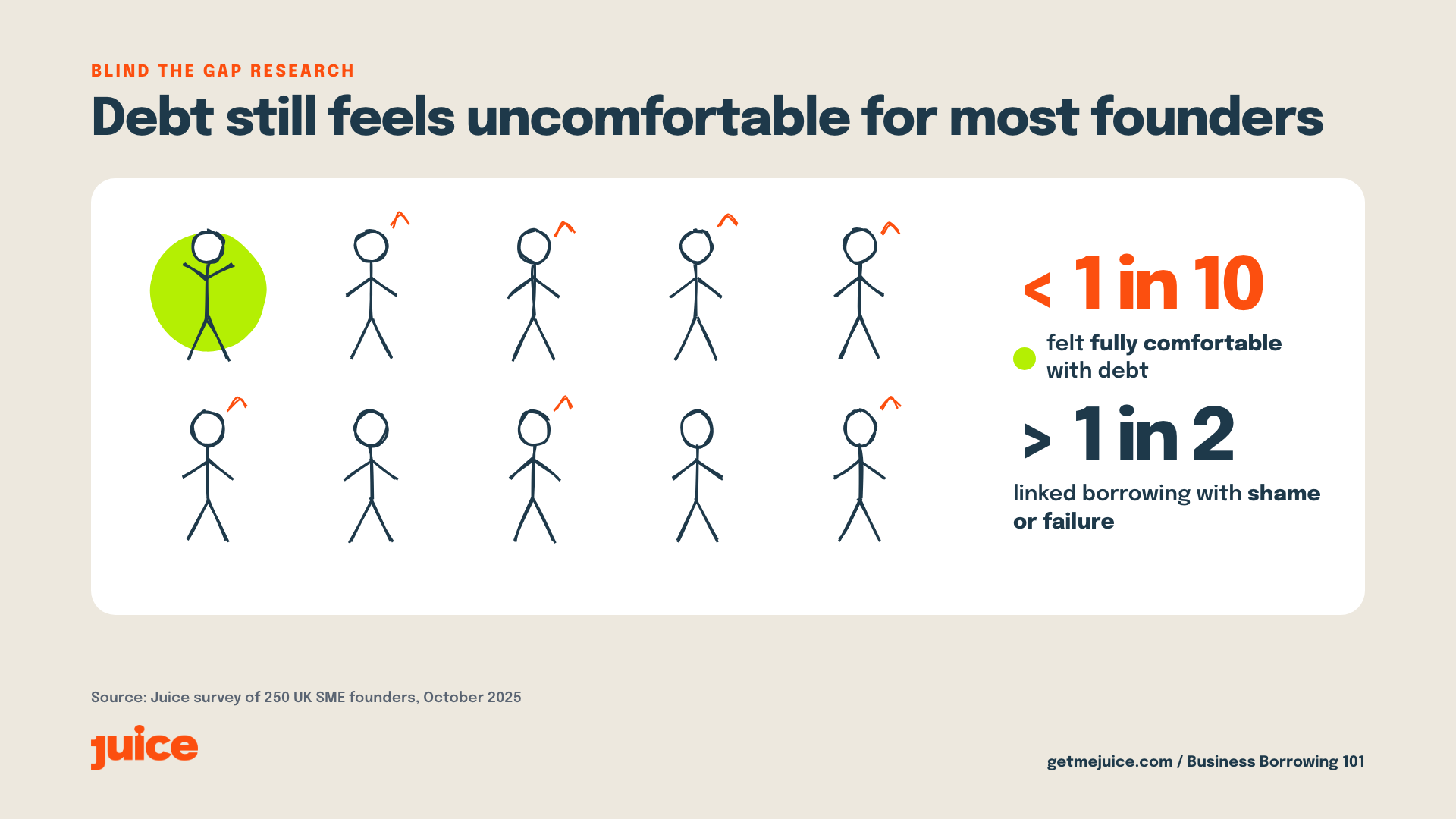
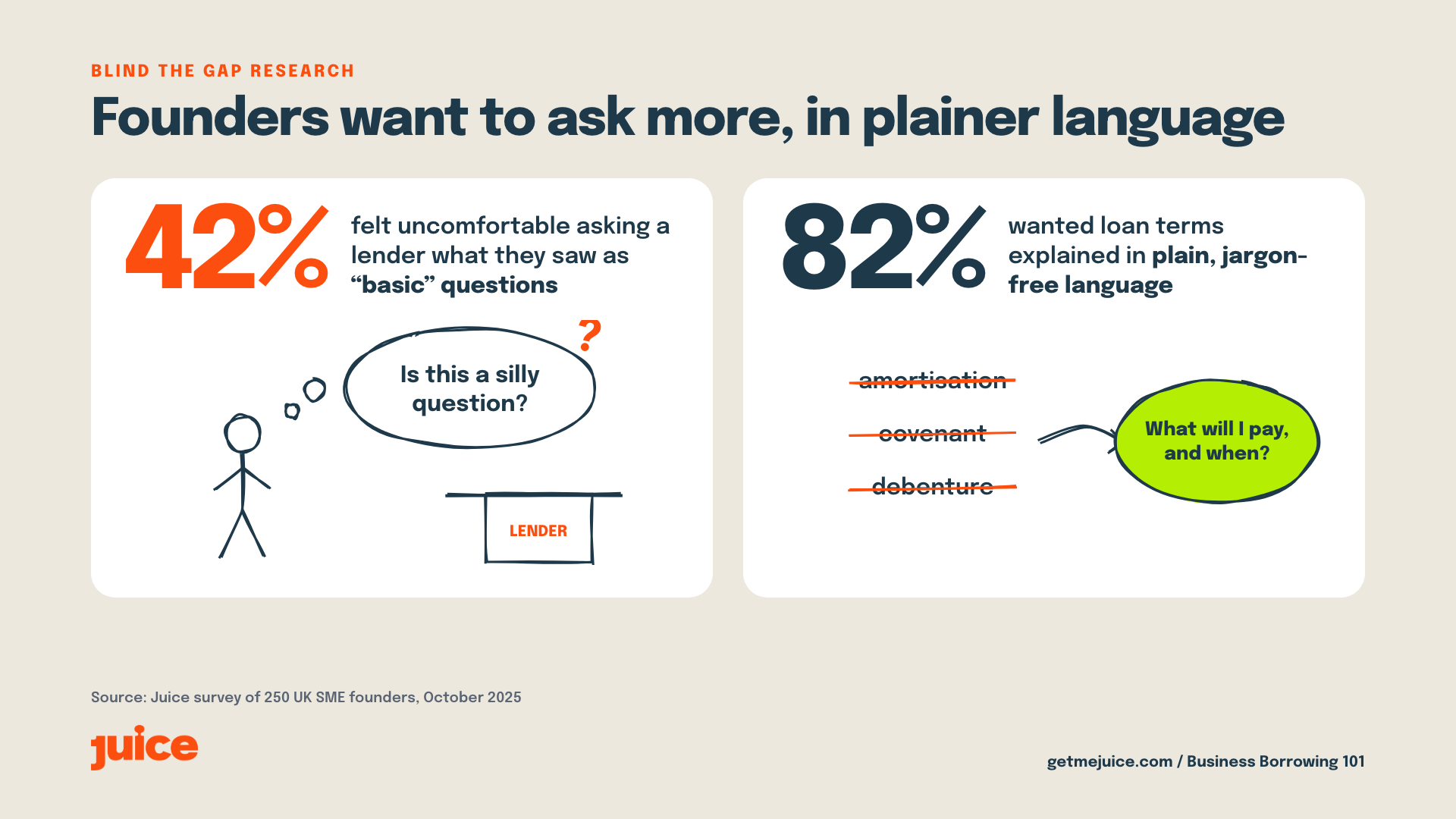
Very. In October 2025 we surveyed 250 founders of small and medium sized enterprises (SMEs) in the UK for our Blind the Gap research, and found hesitation was commonplace. 55% had never applied for finance due to fear of rejection, and 59% had started an application and stopped due to the complexity of the process. More than 50% associated borrowing with shame or failure, less than 1 in 10 was completely at ease with debt, and 42% reported feeling awkward to ask ‘basic’ questions to lenders.

So, if you feel uneasy about borrowing, you are in the majority. Many of the founders we spoke with said the hesitance had nothing to do with their business. Many weren’t sure if they qualified for financing. The 3 questions below are designed to help you check your own numbers before you speak to a lender.
What is the purpose of taking on this debt?
Borrowing money makes sense when the money goes to work to earn or save more than the cost of borrowing.

The reasons that usually work are:
- Buying stock you already have orders for or stock that you sell reliably.
- Meeting the float, i.e. covering the gap between paying your suppliers and getting paid by your customers.
- Purchasing equipment that helps you produce or provide more.
- Taking a supplier’s bulk discount that saves more than the cost of borrowing.
- Getting the business through a seasonal dip that you can see coming, i.e. when the business is otherwise healthy.
Taking the bulk discount example, say a supplier offers you an 8% discount if you order 6 months of stock, and the total order comes to £40,000. The discount means you save £3,200. If you borrow £40,000 for 6 months to pay for the order, and the total costs of borrowing come to less than £3,200, then it works in your favour, and you can check these costs before you speak to anyone.
It’s important to take a step back to consider the big picture if you are thinking of borrowing money to cover losses, pay debts, or put money into a speculative investment, just because you have an offer in front of you.
To test your reasoning, answer this: “This money will let us ______, which will bring in or save ______ by ______.” You need to provide an action, an amount and a date. If you can fill in these 3, a lender will see the same reasoning as you do. If not, you need to work on that part before you apply.
Would you be able to repay it in your quietest month?
This is a numbers question and it is better to answer this yourself before the lender does. Look at your last 6 to 12 months of business bank statements and work out what you were left with each month after you'd paid your suppliers, staff, rent and tax. Consider the low month and not the average.

Let us look at an example. Imagine you are a garden centre and in May you have approximately £14,000 left over at the end of the month but in January you only have approximately £3,000 left over. A monthly repayment of £4,500 is comfortable during spring and summer but in January the business is approximately £1,500 short before anything has been paid. Most business owners carry in their mind what a normal month looks like when they decide on the affordability of the business, so gaps like this are usually ignored.
If a repayment only works in a good month, either the monthly repayment is high or the type of finance doesn't work with how your business income fluctuates. A fixed monthly repayment works well for a business where income is steady. Where income fluctuates, a fixed monthly repayment may not work. Juice Flex is a continuous line of credit that works alongside your business. Whatever type of finance you look at, run the quietest-month check on it first.
To put a figure on the shortfall you'd need to cover, our practical guide to managing cash flow gaps takes you through it step by step.
Is there any way to free up funds without taking on new debt?
Prior to taking a loan, consider the amount of cash locked away inside your company. There might be no need to borrow money at all, or at least to borrow a smaller amount that would make the process of repayment much easier during slower months.
The classic sources to investigate are invoicing and your stock. Invoicing on the day of service and chasing your late payers one week earlier will get you the money you are already owed. In bigger projects, it is normal to ask your clients for a payment before completing the project. This way you get the money from the client that covers the cost of material. Checking your supplier terms is also important. Maybe you have 30 days for payment but have been paying in 10; if you use the whole period, you keep the money in your account for an additional 3 weeks. Slow-moving stock is money you have already paid for, so clearing some of it, even at a smaller margin, turns it back into money you can use.
None of these will pay for a big investment on its own. Together they often bring the amount you need down, sometimes by more than you'd expect.
What is the cost of delaying the decision to borrow?
Prudence around borrowing is understandable, but ruling it out by default has a cost of its own. It is hidden because it is not visible on your bank statement.
According to the survey, 27% of respondents considered debt as a growth tool. In contrast, more than half of founders postponed or scrapped their growth plans due to lack of financing, while this share amounted to 64% among companies that were less than 5 years old. As most of the founders did not apply at all, their plans were shelved before receiving an answer from a lender.

Delaying your plan is the correct thing to do if your analysis says that the timing is not right. What the 3 questions help you ensure is that you have done that analysis and that this is the reason for your delay.
Should your business go for borrowing?
If your business has a definite objective, manageable repayments even in your quietest months, and you have considered using funds from within your business before borrowing, then you are well placed to begin the process of lender comparisons. Where this is not the case, it will be more prudent to deal with this aspect first and apply in a few months with a stronger case.

Once you're there, the next decisions are how much to borrow and which type of finance suits your business. Our guide to the types of business finance in the UK explains how each one works. If you've applied before and been turned down, why the bank says no covers the most common reasons and what you can do about them.
Survey figures: Juice survey of 250 UK SME founders, October 2025. The garden centre and bulk discount figures are illustrative examples. This article is general information and isn't financial, legal or tax advice. For advice on your specific situation, speak to your accountant or a qualified adviser.
Juice lends to UK limited companies. All funding is subject to status and lending criteria.