


Cash flow management for seasonal UK businesses: a practical guide
This article is part of our guide to Working Capital.
Edited by the Juice editorial team. Last updated: July 2026.
Seasonal businesses don't run on a calendar that finance textbooks recognise. Revenue arrives in concentrated bursts, costs run year-round, and the gap between the two is where most owner-managers feel the pressure. This guide walks through 7 practical steps for managing that cycle, so the quiet months stop being a crisis and start being a planning window.
Why seasonal cash flow is different
Most business finance advice is written for businesses with relatively predictable, month-to-month revenue. A seasonal business doesn't work like that.
A beach cafe in Cornwall might take 70% of its annual revenue between June and September. A ski equipment rental shop in the Scottish Highlands generates most of its income in a 4-month winter window. A garden landscaping company in the East Midlands has a quiet December through February, then scrambles to fulfil 6 months of booked jobs from March onwards.
In each case, the business has fixed costs such as rent, insurance, and perhaps a permanent member of staff that continue through the quiet period. It also has preparation costs, including seasonal staff wages, inventory, equipment maintenance, and marketing campaigns, which arrive weeks or months before peak revenue does.
This creates what cash flow planners call the pre-season trough: a period where outgoings are rising steeply, income is still low or absent, and the business is running on reserves or external finance.
Managing the pre-season trough well is the difference between entering peak season ready to trade at full capacity and entering it under-resourced, short-staffed, and scrambling. We cover this in more detail in our guide to bridging the quiet season.
Step 1: map your annual cash flow cycle
Before you can manage seasonal cash flow, you need to understand it precisely. That means building a 12-month forecast that goes beyond simple profit projections and maps the actual timing of money in and money out.
Start with your income profile:
- The months when revenue arrives, and the typical share each month contributes to the annual total.
- The lag between a sale and the funding reaching your account, which matters for deposit-led businesses (weddings, holiday lets) where bookings arrive months ahead of the service date.
- Year-on-year variability, so you're forecasting against a realistic range rather than a single optimistic line.
Then map your outgoings by category:
- Fixed costs that run every month regardless of revenue (rent, rates, insurance, standing charges, permanent payroll).
- Preparation costs that cluster in the weeks before peak season (recruitment, training, inventory, marketing).
- Variable costs that scale with trade itself (cost of goods, hourly wages, utilities at peak load).
- One-off costs such as equipment refurbishment, licensing, or compliance work.
The gaps in your forecast, the months where outgoings exceed incomings, are where you need a plan. Don't wait until you're in the trough to figure out how you'll cover it.
Step 2: know your numbers before the quiet season hits
The biggest mistake seasonal business owners make is arriving at the quiet season without a clear picture of their financial position. By October, a hospitality business that had a strong summer should know:
- Total revenue for the season, against forecast and against the previous year.
- Net profit after seasonal costs are settled, not just the gross take.
- Reserves available to carry the business through to the next peak, expressed as months of fixed costs covered.
- The shortfall, if any, between reserves and the expected quiet-season outgoings, and how that gap will be funded.
This sounds obvious, but the reality for many owner-managed businesses is that the busy season leaves no time for financial planning. The accounts get reconciled in November and the picture becomes clear too late.
Build a post-peak review into your calendar, ideally in the first 2 to 3 weeks after your season closes. Use it to reconcile the year, stress-test your winter cash position, and make decisions about financing before you're under pressure.
Step 3: separate your quiet-season costs into categories
Not all quiet-season costs are equal. When you're planning how to fund the off-season, it helps to think in 3 buckets.

1. Fixed costs you must cover regardless
Rent, rates, insurance, standing charges, permanent staff salaries. These are non-negotiable. If your business generates no income from November to March, these still need to be covered. Build them into your forecast and make sure you have either the reserves or a credit facility ready to cover them.
2. Preparation costs that generate the next season's revenue
This is the investment bucket, the spend that directly enables peak season. Seasonal staff recruitment and training, inventory orders, equipment upgrades, marketing campaigns. These are costs worth funding externally if reserves don't stretch to them, because they have a direct return in the season ahead.
3. Discretionary spend that can be deferred
Refurbishments, new equipment that isn't operationally critical, expansion plans. These can often be timed to align with post-peak revenue, or deferred to a later year without damaging the core business.
Understanding which bucket each cost falls into helps you decide what to protect, what to fund with external finance, and what to push back.
Step 4: build a reserve fund
The most financially resilient seasonal businesses treat the peak season partly as a savings exercise. A proportion of peak-season profit goes into a designated reserve fund that covers the quiet-season fixed costs.
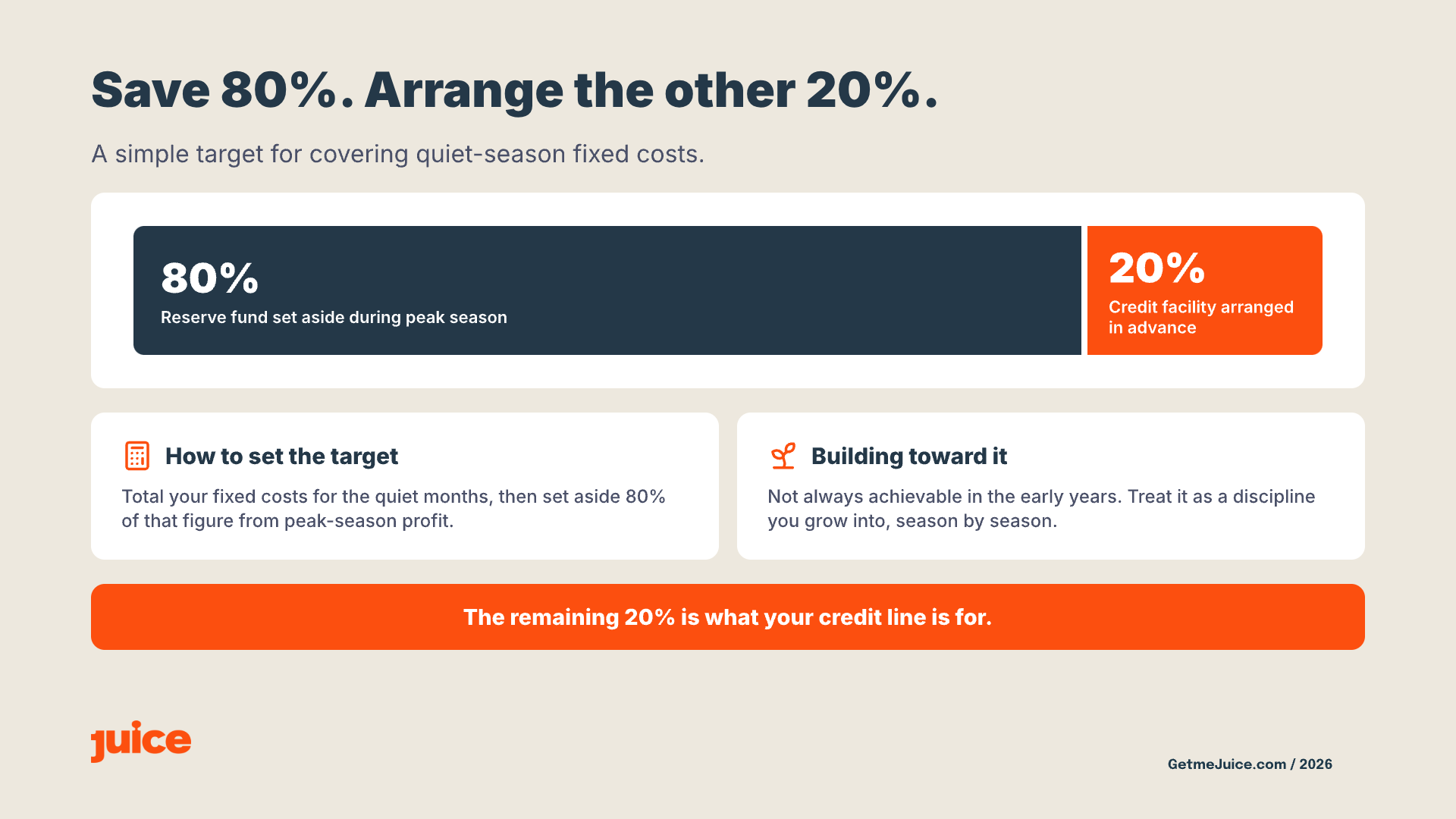
A simple formula: calculate your total fixed costs for the quiet period, then set a target to accumulate at least 80% of that figure as a cash reserve during peak season. The remaining 20% can be covered by a credit facility.
This isn't always achievable in the early years of a business, or in a year where the peak season underperforms. Building toward it as a discipline gives you progressively more control over your cash flow cycle.
Step 5: use external finance as a planning tool, not a rescue measure
Many seasonal businesses only think about finance when they're already in trouble, where the bank balance is running low and the pressure is on. At that point, the options narrow and the terms worsen.
The better approach is to treat external finance as a planned component of your annual operating model, arranged well in advance of the quiet season. If you're currently servicing a fixed-term loan and finding it doesn't flex with your season, our guide to switching from a business loan to revolving credit walks through the trade-offs.
A revolving credit facility suits seasonal cash flow particularly well because of how it works:
- The facility is approved once and then sits ready, so you're not negotiating finance in a crunch.
- You draw on it when you need to, in the amount you need, rather than taking a lump-sum loan you don't fully use.
- You repay it as revenue arrives, and the balance becomes available to draw again.
- You only pay for what you use, so a facility that sits idle in March doesn't cost you the same as one drawn to the limit.
For a business with a predictable annual cycle, a revolving credit facility behaves almost like a rolling operating line: always available, priced proportionally to use, and naturally synchronised with seasonal revenue. If you've been weighing this against a merchant cash advance, our MCA vs revolving credit comparison breaks down where each ends up cheaper across a full season.
Juice Flex is a continuous line of credit that works alongside your business.
Step 6: manage staff costs carefully
For most seasonal businesses, staffing is the largest variable cost. Seasonal staff recruitment, induction, and training is expensive, and it often happens in the pre-season period before revenue starts.
Strategies to manage seasonal staffing costs:
- Build a core of returning staff each year, so recruitment and training costs fall the longer the business runs.
- Stagger start dates so wages only kick in as the trading week ramps up, rather than paying a full team to sit idle in the soft-opening weeks.
- Use a mix of permanent, part-time, and short-contract roles to match labour cost to actual demand through the season.
- Track wage cost as a percentage of weekly revenue and adjust hours week by week, not just at the start and end of the season.
When external finance is needed to cover a wage bill before the revenue arrives, a revolving credit facility lets you draw what's needed for that specific payroll without taking on a lump-sum term loan you'll still be repaying long after the need has passed.
Step 7: don't under-invest in off-season marketing
One of the most common quiet-season mistakes is cutting the marketing budget to zero because there are no customers in the shop. For seasonal businesses that depend on advance bookings (holiday accommodation, wedding venues, seasonal experiences) the off-season is when next year's peak season is being booked.
A hotel that stops marketing in November risks arriving at the following summer without the forward bookings that give it confidence to staff up and stock up. A wedding venue that goes quiet on social media through winter may find that engaged couples booking for the following year have already chosen a competitor who stayed visible.
Off-season marketing spend is often the highest-leverage spend in the year. It's worth including it in your cash flow plan as a deliberate investment, not a discretionary extra.
Putting it together: a seasonal cash flow calendar
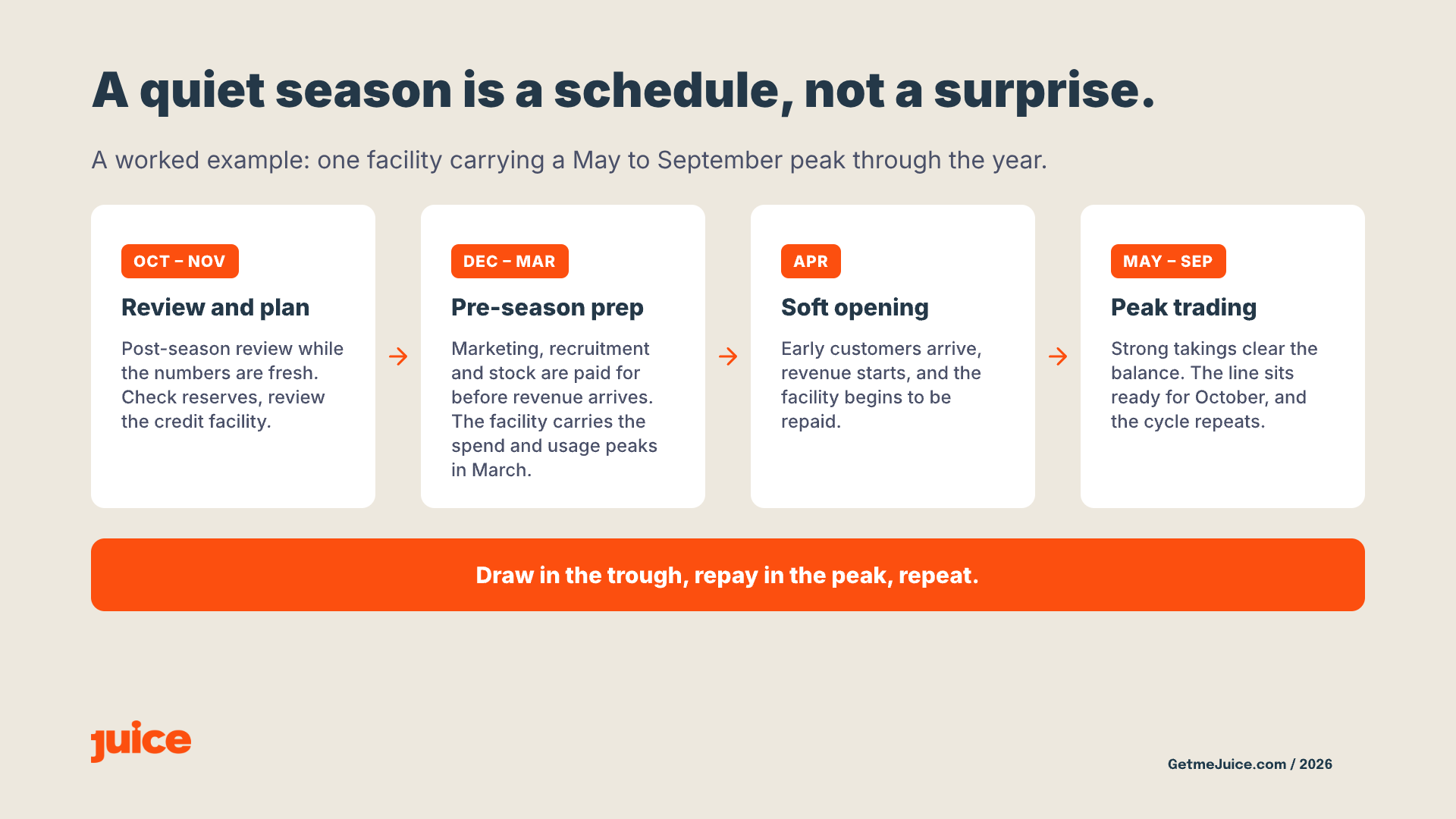
Here's a simplified picture of how the year might look for a coastal hospitality business with a May–September peak season. It's illustrative rather than prescriptive, so use it as a shape to test against your own numbers.
October is the post-season review and reserve-fund assessment. Cash is positive because peak revenue is recent, which makes it the best moment to plan the next 12 months honestly.
November is for fixed-cost budgeting and credit facility review. Reserves start to be drawn on, but the position is still comfortable if the season went to plan.
December is staff planning and any maintenance work that has to happen before pre-season prep begins. Reserves cover the fixed costs.
January is when marketing campaigns launch and advance bookings open. This is typically the first month a credit facility starts to be drawn on, because marketing spend arrives well before bookings convert to deposits.
February is seasonal staff recruitment and the first training costs. The facility carries the staffing prep.
March is stock orders, equipment checks, and final pre-season spend. Facility usage usually peaks here.
April is the soft opening and early-season customers. Revenue starts arriving and the facility begins to be repaid.
May to September is full operation. Strong revenue clears the facility balance, and it sits ready to be drawn on again in October as the cycle repeats.
The credit facility acts as the bridge between January and May. Revenue repays it. The facility is there again in the following autumn for the cycle to repeat.
How a revolving credit facility works in practice
For a seasonal business, the practical question is how to fund the build-up to your peak and then repay once the season's revenue arrives. A revolving credit facility works differently from a one-off advance. You apply once, and once the facility is approved it stays in place as an agreed limit you can draw against when you need to, rather than a single lump sum paid out on day one.
Drawing down funds. When you need funding, you request a drawdown against your available limit. Each drawdown is subject to a short affordability check rather than being released automatically, and you draw only the amount you need for that purpose.
How repayment works. You repay the drawn balance over a term of up to 24 months per draw, with interest-only options available to ease pressure on cash flow. Repayment is built to flex with how you trade rather than lock you into one rigid schedule. "No early-repayment penalty" means what it says: if you clear a balance ahead of schedule you stop accruing interest from that point, with no exit fee and no charge for repaying early, so strong cash flow directly lowers what you pay.
How you are charged. Interest is charged only on the balance you have drawn, not on the full facility, so a facility that is unused or only partly drawn costs less than one that is fully drawn. We cannot show a specific interest rate here without a representative example, so the rate is confirmed on your individual offer.
Who it suits, and how big a facility. Facilities run from £50,000 to £1 million, so the same structure supports a first-time borrower opening a smaller line through to a scaling business drawing toward the top of the range. A seasonal retailer or hospitality business can open a line ahead of its peak, draw against it to cover stock, seasonal staff, and marketing through the pre-season trough, then repay as the season's takings come in.
Common questions
How do you forecast a seasonal cash flow gap before it arrives?
Start by laying out a 12-month view of money in and money out, then look for the run of months where outgoings are higher than income. For a seasonal business the gap usually opens in the weeks before the peak, when preparation costs such as stock, recruitment, and marketing land while revenue is still low. Estimate each month's shortfall using a realistic revenue range rather than your best year, add the cumulative position across the quiet stretch so you can see the deepest point, and build in a margin for the season opening later or softer than hoped. The deepest cumulative point is the size of gap your plan has to cover.
How do you size a funding facility to a seasonal peak?
Work from the forecast rather than a round number. Take the deepest cumulative shortfall from your 12-month view, subtract the reserves you expect to have set aside by then, and the remainder is roughly the funding headroom your peak actually calls for. It is sensible to add a modest buffer for timing slippage, because deposits and takings rarely arrive exactly on schedule, but an oversized line tends to invite borrowing you do not need. Sizing to the forecast gap keeps the facility matched to the real shape of your trading year rather than to a worst-case guess.
What can a seasonal business do to ease the cycle without borrowing?
Several levers reduce the depth of the trough before finance comes into the picture. Setting aside a share of peak-season profit into a reserve builds a cushion for the quiet months. Negotiating staged or seasonal payment terms with suppliers can shift costs closer to when revenue arrives. Adding a complementary off-peak revenue line, such as events, off-season hire, or a different customer segment, smooths the income curve. Phasing preparation spend so it falls as late as the season allows, and timing discretionary projects to land just after the peak, both keep the pre-season dip shallower and easier to fund.
The guide and useful links
This article is part of our guide to Working Capital. Other articles in this guide:
- How to bridge the quiet season without cutting your business short
- From Stockroom to Sales Floor: Funding That Moves at Your Pace
- Alternative Business Loans: Flexible Funding for UK SMEs
Summary
Seasonal cash flow management comes down to 5 disciplines:
- Build a 12-month forecast that maps the timing of money in and money out, not just annual totals.
- Close out each peak season with a financial review while the numbers are still fresh.
- Separate quiet-season costs into fixed, preparation, and discretionary so funding decisions match the cost type.
- Build a reserve fund that covers most of the quiet-season fixed costs, with a credit facility ready for the remainder.
- Arrange external finance as part of the plan, not as an emergency response.
The businesses that manage seasonal cash flow well don't do it by luck or by working harder. They do it with a clear plan and the right financial tools in place before the pressure arrives.
If you'd like to discuss how a revolving credit facility could work for your business, talk to the Juice team.