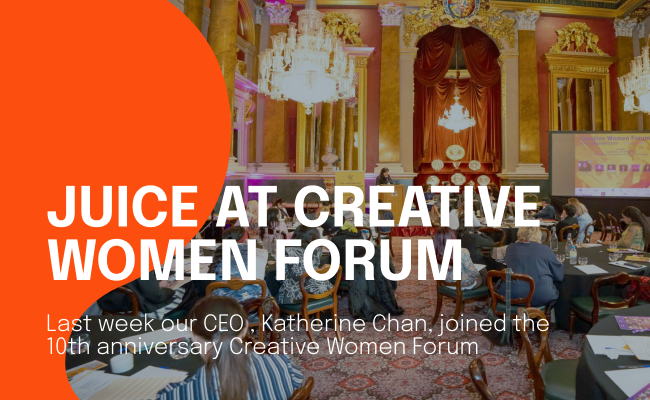


Juice at Creative Women Forum
Last week our CEO Katherine Chan, joined the 10th anniversary Creative Women Forum at Goldsmiths' Hall, speaking on a panel called Capital in Motion. The room brought together founders, investors and operators from around the world, and the conversation kept returning to a question we care about more than almost any other at Juice: who actually reaches growth finance, and who quietly counts themselves out long before they ever apply.
One number framed the whole discussion for us, so we wanted to set it down here.

The barrier is not supply
For a long time the funding gap has been described as a supply problem, as though the only thing standing between a small business and growth was a lender willing to say yes. Our own research suggests that is the smaller half of the story.
We explored this in our recent whitepaper, Blind the Gap, which surveyed 250 UK founders, and the pattern was hard to argue with. The real barrier is confidence and comprehension, not the availability of finance:
- 55% never started an application at all, held back by fear of rejection rather than actual ineligibility
- 59% began one and abandoned it midway because it was too complex
- 23% signed agreements they did not fully understand, and 42% were too embarrassed to ask a basic question
- 82% want plain-language terms, a near-universal demand that is almost entirely unmet
- Only 27% see debt as a strategic tool rather than a last resort
Put those together and you reach the figure we keep returning to. Half the funding gap is people who never apply. The British Business Bank puts the SME funding gap at around £22 billion, and a large share of it is driven by shame, complexity and a process built for the lender rather than the founder. That is not a credit problem. It is a confidence problem, and it shows up as growth that never happens. More than half of the founders we surveyed had delayed or cancelled growth plans, from new products to market expansion to hiring.
The confidence gap is not gender-neutral
This is where the Creative Women Forum framing mattered, because confidence is not distributed evenly.
Research from Oxford Saïd Business School found that a founder's confidence to ask for funding rises by 49% with business education, and women are disproportionately excluded from the networks and rooms that build that confidence in the first place. The result is visible in the numbers. Female founders ask for £149,000 on average, against £205,000 for all-male teams, despite near-identical success rates once they do apply, 43% versus 45%.
Read that carefully. Women are not less fundable. They are under-asked and under-backed. The gap opens upstream, in who feels entitled to apply, not downstream in who gets approved. Any serious conversation about access has to start there
Blind is not automatically fair
At Juice we underwrite the business, not the founder. We look at real-time revenue, cash flow and transaction data, and there is no field in the model for gender, age, ethnicity or education. So we can ask a question most lenders cannot: when you take the person out of the decision, does the gap still appear?
"We underwrite the business, not the founder. But blind isn't automatically fair, it depends what you choose to look at. Collateral and credit history proxy for who already had wealth. Forward-looking data proxies for who can perform. That choice is where fairness actually lives."
— Katherine Chan, CEO & Co-founder, Juice
The uncomfortable answer is that removing the person is necessary but not sufficient. Blind is not automatically fair, because it depends entirely on what you choose to look at. Collateral requirements and credit history are not neutral inputs. They quietly proxy for who already had wealth, not for who can perform. Forward-looking data, by contrast, proxies for who can actually trade and repay. That choice of inputs is where fairness genuinely lives, well before any decision is made.
Which is why every lender, fund and family office should ask a sharper version of the usual question. Not only "is our process fair?" but "who never reaches our process, and why?" The answer to the access gap sits in that question, not in the decision layer.
AI is a choice, not a verdict
Much of the panel turned to AI, and whether it will finally strip the subjectivity out of lending decisions. Our view is that it can, but it will not do so by default.
Trained on real-time financial data rather than a credit history, a postcode or a name, AI can remove the human subjectivity that has disadvantaged women and non-traditional founders for decades. That is the genuinely good version. The risk is the mirror image: AI trained on historical approval data simply institutionalises yesterday's bias, now at scale and at speed. Most lenders cannot tell you what their training data looks like demographically, which means they cannot tell you whether their model is fair.
Governance has focused almost entirely on explainability and outputs, on being able to justify a decision after it is made. The bias lives earlier than that, in the input layer, before the model decides anything at all. The question worth asking more loudly is a simple one: who audits the training data? Automate the past and you scale the problem. Build on forward-looking data and an ongoing relationship with the borrower, and you get a model that is both fairer and more accurate. It is a choice, not a verdict.
The market small businesses cannot see
It is worth naming where all the noise about private credit actually sits, because it is easy to assume the money sloshing around the headlines is reaching small business. It is not.
Private credit has grown to roughly $3.5 trillion globally, but it is concentrated in the mid-market and above, and even at its lower end it targets companies far larger than a typical small business. The recent reset you may have read about, with retail redemption requests running ahead of the caps designed to hold them, is a liquidity and wrapper problem rather than a failure of the underlying lending. A loan does not default because an investor wants their money back early.
None of that touches the £22 billion SME gap. Banks retreated from bespoke small-business lending after 2008, when post-crisis capital rules made it expensive and low-margin, and the small business fell into a blind spot: too small for relationship banking, too bespoke for a credit score built for mortgages. That blind spot is exactly the space we set out to serve.

What we took away
The most useful thing any of us in finance can do is widen the front door, rather than only speed up what happens once someone is inside. That means plain-language terms, explaining the reasoning behind a decision so a founder knows what to fix and can come back, and designing the application for the 55% who never start rather than the minority who find the current process easy.
At Juice we built Juice Flex, a revolving credit facility for UK SMEs, around how businesses actually trade, and we judge the business rather than the founder. But the broader point outlasts any one product. If half the gap is people who never apply, the work is as much about confidence as it is about credit. Subject to status and lending criteria.
Our thanks to the Creative Women Forum, the moderator and the fellow panellists for a conversation that was every bit as sharp as the room. If you are a founder reading this and wondering whether you are fundable, the data says the same thing we would: ask. You are far more likely to be under-asking than over-reaching.