


How To Get Lender-Ready: What UK Lenders Check And How To Prepare
This is part of our business loans in the UK guide and chapter 3 of Business Borrowing 101, our free guide for first-time borrowers.
A good reason to borrow and a clear idea of how much your business needs are where an application starts. After that, every lender runs its own assessment, and each one weighs things a little differently. There's a lot you can do in advance to show your business at its best, and because some of it takes months, it helps to start well before you apply.
Is it normal to worry about being turned down?
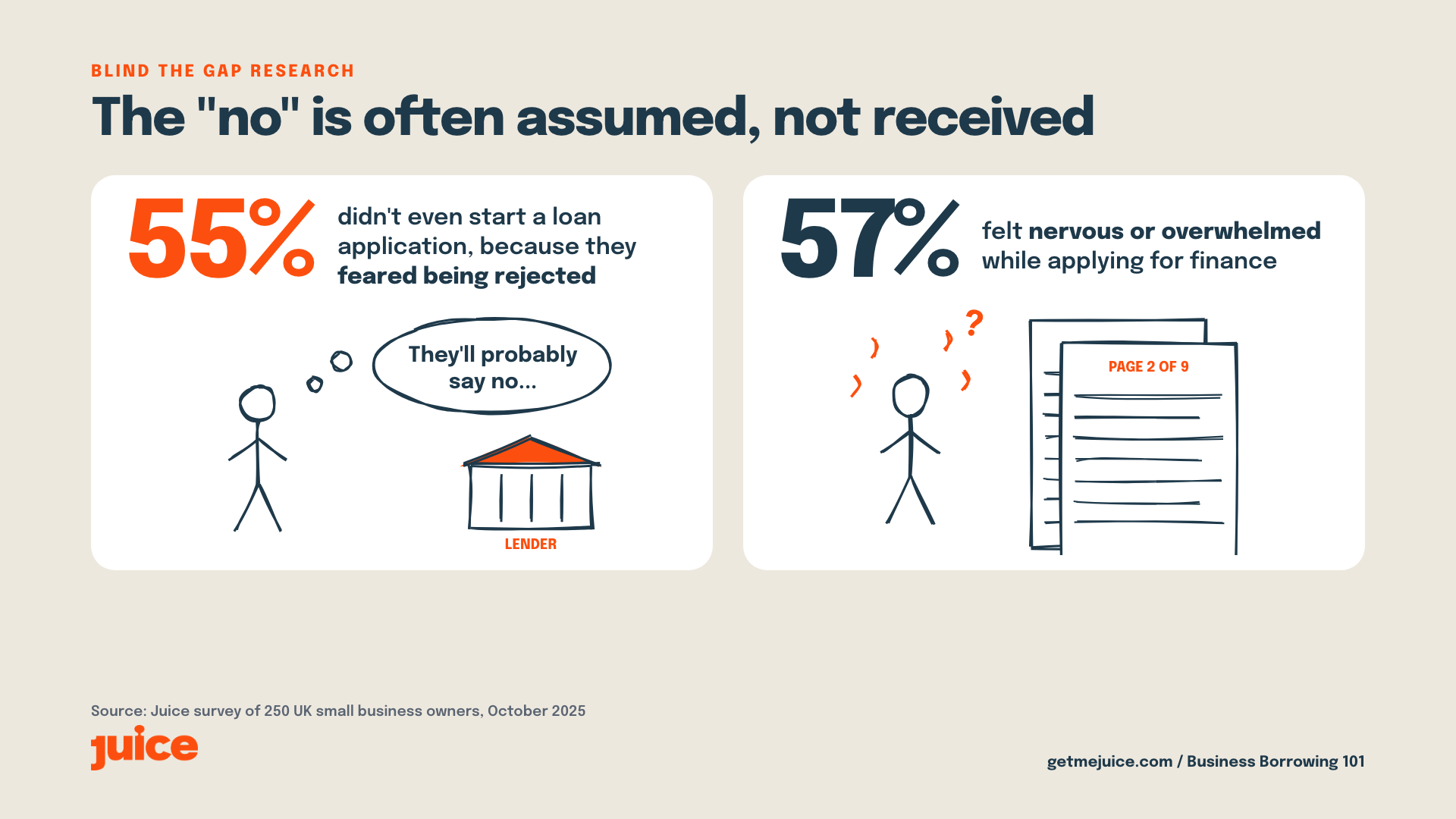
Yes, and the worry stops a lot of business owners before they start. When we surveyed 250 owners of UK small businesses for our Blind the Gap research in October 2025, 55% hadn't even started a loan application because they feared being rejected, and 57% said they felt nervous or overwhelmed while applying for finance. For many of them, the "no" was assumed and never came from a lender.
What do lenders look at?
Most lenders check the same 7 things:
- Trading history. How long your business has been trading. Many lenders want at least 12 months, and some banks, or larger loans, may want 2 or 3 years.
- Revenue. Whether the business brings in enough to make the repayments. Many newer lenders check this from your live bank or accounting data, as well as your filed accounts, which can be 9 to 18 months out of date.
- Cash flow pattern. How steadily the money comes in, as well as how much. Lenders want to see whether income is regular or bunched into a few months, and whether your existing bills are covered comfortably.
- Business credit profile. Your company's record with credit reference agencies such as Experian, Equifax and Creditsafe, including payment history, any county court judgments (CCJs) and how long the company has been registered.
- Directors' personal credit. For smaller businesses in particular, lenders usually check the directors' personal credit records too.
- Existing debts. What the business already owes, and whether a new repayment on top is realistic.
- Security and guarantees. Some lenders ask for security over business assets, and many lenders to smaller businesses, banks and alternative lenders alike, ask a director for a personal guarantee.

If you're looking at revolving credit, our article on what lenders look at when approving revolving credit goes through each one for that product.
Which lending terms do small business owners find hardest to follow?
Some of these factors are hard to read if you've never borrowed before. In our survey, 41% of small business owners found collateral and guarantees the hardest terms to understand, 36% said interest rates, 27% said the application process and 25% said credit checks and criteria.

If any of those apply to you, you can ask a lender to explain them before you go any further. A lender should be able to answer in plain language, and if it can't, that's worth noting before you sign anything.
How can you prepare your business before you apply?
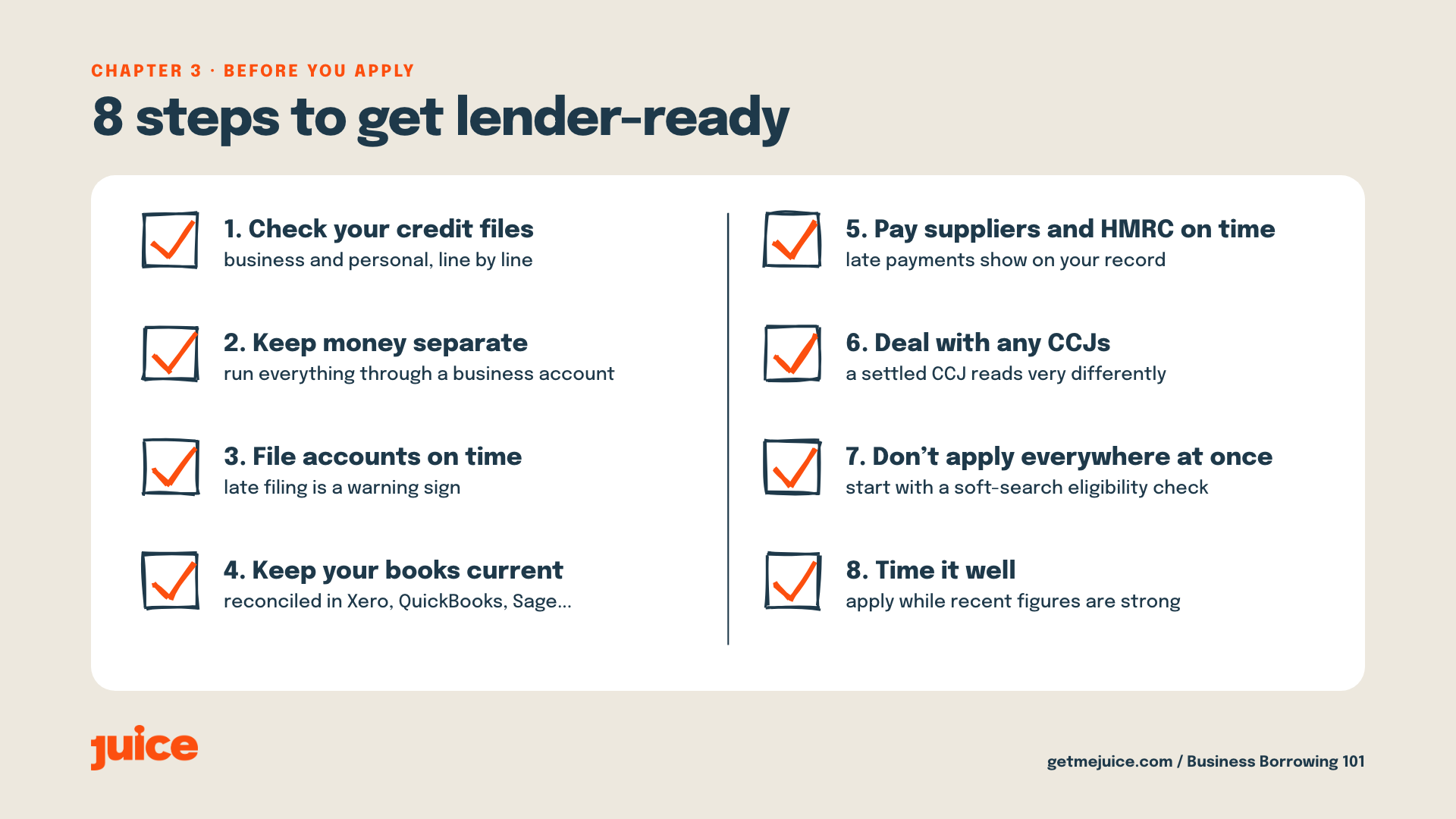
These 8 steps all help a lender read your business clearly:
- Check your credit files before a lender does. You can get your business and personal files from the main agencies, and it's worth reading every line, because a wrong address, an old account you thought was closed or a debt that isn't yours can all count against you. If you find a mistake, you can ask the agency to correct it.
- Keep business and personal money separate by running everything through a business bank account. When the two are mixed, a lender has a much harder time seeing how the business trades.
- File your accounts on time. Companies House filings are public, so a late one is easy for a lender to spot, and the more recent your accounts are, the less a lender has to lean on old numbers.
- Keep your books up to date in whatever software you use, whether that's Xero, QuickBooks, Sage or FreeAgent. Many lenders connect to it directly, so a backlog of unreconciled transactions is part of what they see.
- Paying suppliers and HMRC on time matters too, because late payments appear on your business credit record. Even a few months of paying on time before you apply helps.
- Deal with any CCJs. If you have a county court judgment and can settle it, do, because a lender reads a settled CCJ very differently to an outstanding one.
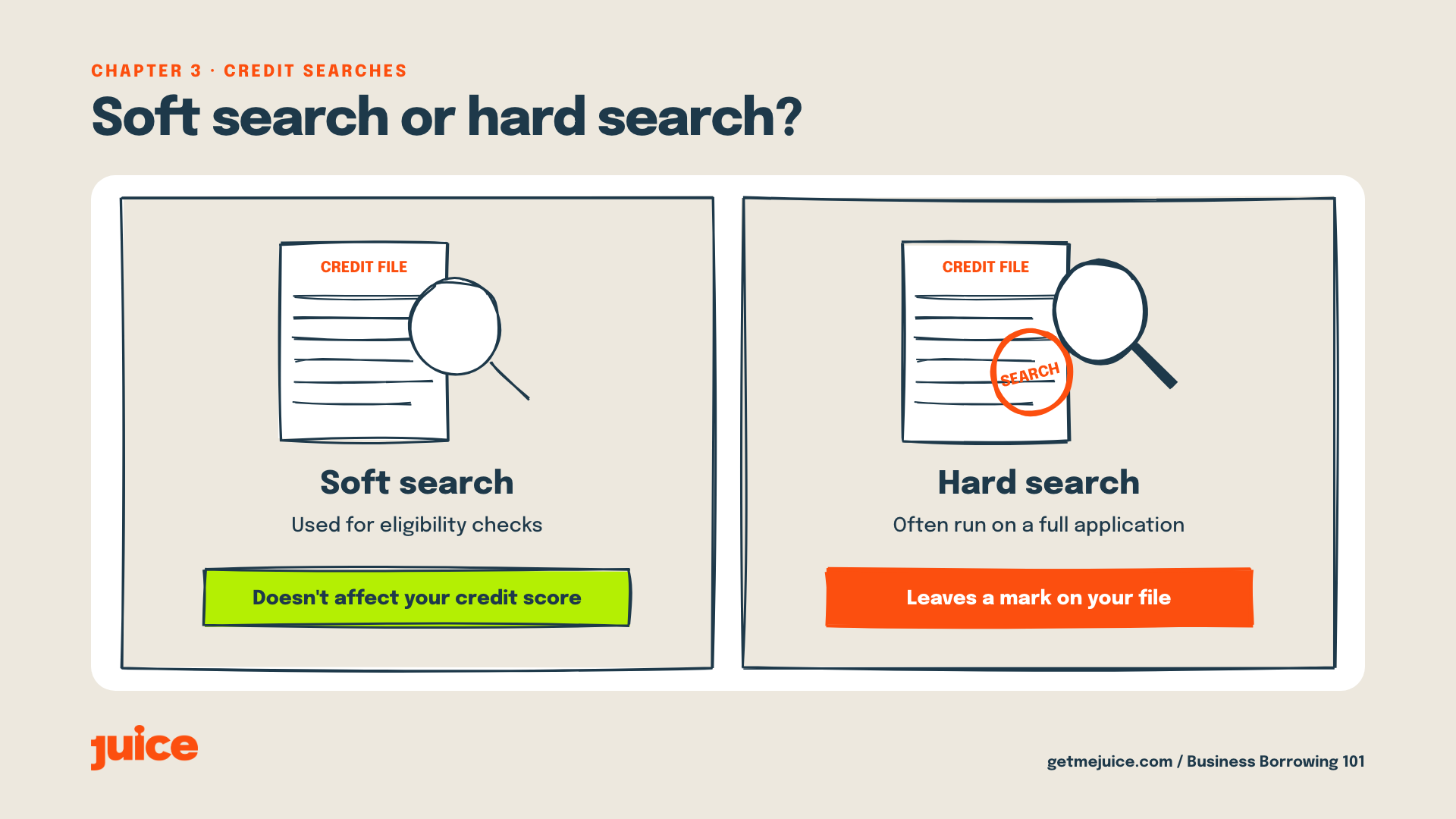
- Don't apply everywhere at once. A full application can trigger a "hard" credit search, which leaves a mark on your file, and a lender who sees several of those close together may wonder why. Eligibility checks that use a "soft" search don't affect your credit score, so start there.
- Time it well. If you know a quiet season is coming, it's better to apply while your recent figures are strong than to wait until they've dipped.
When you compare lenders, ask each one whether its first check is a soft or a hard search.
What should you do if a lender says no?
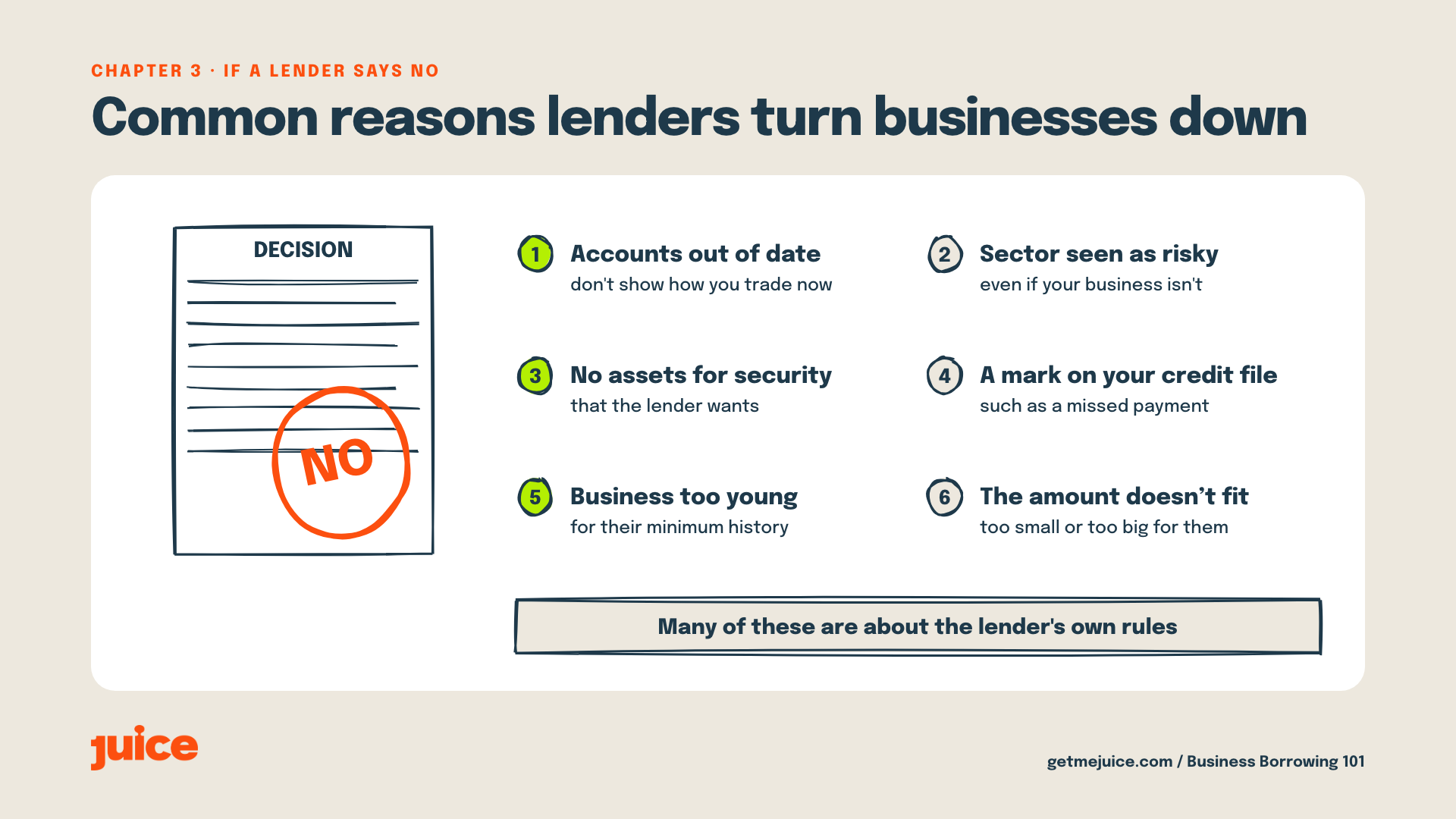
A decline from one lender isn't the end of it. Lenders turn down plenty of good businesses, often for reasons that say more about their own rules than about your business. Common reasons include:
- Your filed accounts are out of date and don't show how the business is doing now.
- Your sector is seen as risky, even if your own business isn't.
- You don't have the assets the lender wants as security.
- There's a mark on your credit file.
- Your business is younger than the lender's minimum trading history.
- The amount doesn't suit the lender, because it's too small to be worth their while or too big for the size of your business.
Our article on why your bank keeps saying no goes through the reasons banks give most often. If it's happened to you, work through these 5 steps:
- Ask the lender exactly why you were declined, because the reason tells you what needs to change.
- Go back to your credit files and look for errors before you apply anywhere else.
- Look at other lending products. If what you need is working capital, a different type of finance may fit better, and our guide to the types of business finance in the UK explains the options.
- Try a different kind of lender. Alternative lenders look at different information, such as live bank data. They usually cost more than a secured bank loan, because they're pricing for the risk they take on.
- Keep building towards your next application by keeping your accounts current and your credit clean, so the lender has a clearer picture when you go back.

Being turned down once doesn't stop you applying somewhere else, and other lenders won't automatically count it against you. Our article on revolving credit after a rejection covers what changes when you apply again.
What comes after getting lender-ready?
Once your business is in good shape for an application, the next decision is which type of finance fits the need. Chapter 4 of Business Borrowing 101 compares the main types side by side, and if you haven't yet decided whether to borrow at all, start with our 3-check test.
Survey figures: Juice survey of 250 UK small business owners, October 2025. This article is general information and isn't financial, legal or tax advice. For advice on your specific situation, speak to your accountant or a qualified adviser.
Juice lends to UK limited companies. All funding is subject to status and lending criteria.