


How Much Should Your Business Borrow? How To Work Out Your Cash Flow Gap
This is part of our business loans in the UK guide and chapter 2 of Business Borrowing 101, our free guide for first-time borrowers.
Once you've decided that borrowing makes sense for your business (our 3-check test helps with that), the next question is how much, and a lot of first-time borrowers get this part wrong. If you borrow too little, you'll probably be back asking a lender again within a few months, and if you borrow too much, you pay for money that sits in your account unused. The way to get the number right is to measure your cash flow gap, and below are 2 ways to do it.
Why does a profitable business run short of money?
Profit and cash don't arrive at the same time. Say you pay a supplier for stock in March, the stock sells in April and your customer pays the invoice in May. For those weeks the business has paid for the sale out of its own account, and that stretch is your cash flow gap. Our guide to the working capital cycle explains how it builds up.

The gap often grows as a business does well. New orders keep coming in before the earlier ones have been paid for, so a growing business can run short of money in the same months its sales are strongest. It's the cash flow gap that catches out a lot of UK SMEs.
How do you measure your cash flow gap?
There are 2 ways. The quick method gives you a rough figure in about 10 minutes, and the weekly method gives you a number you can plan with.
The quick method: your cash conversion cycle
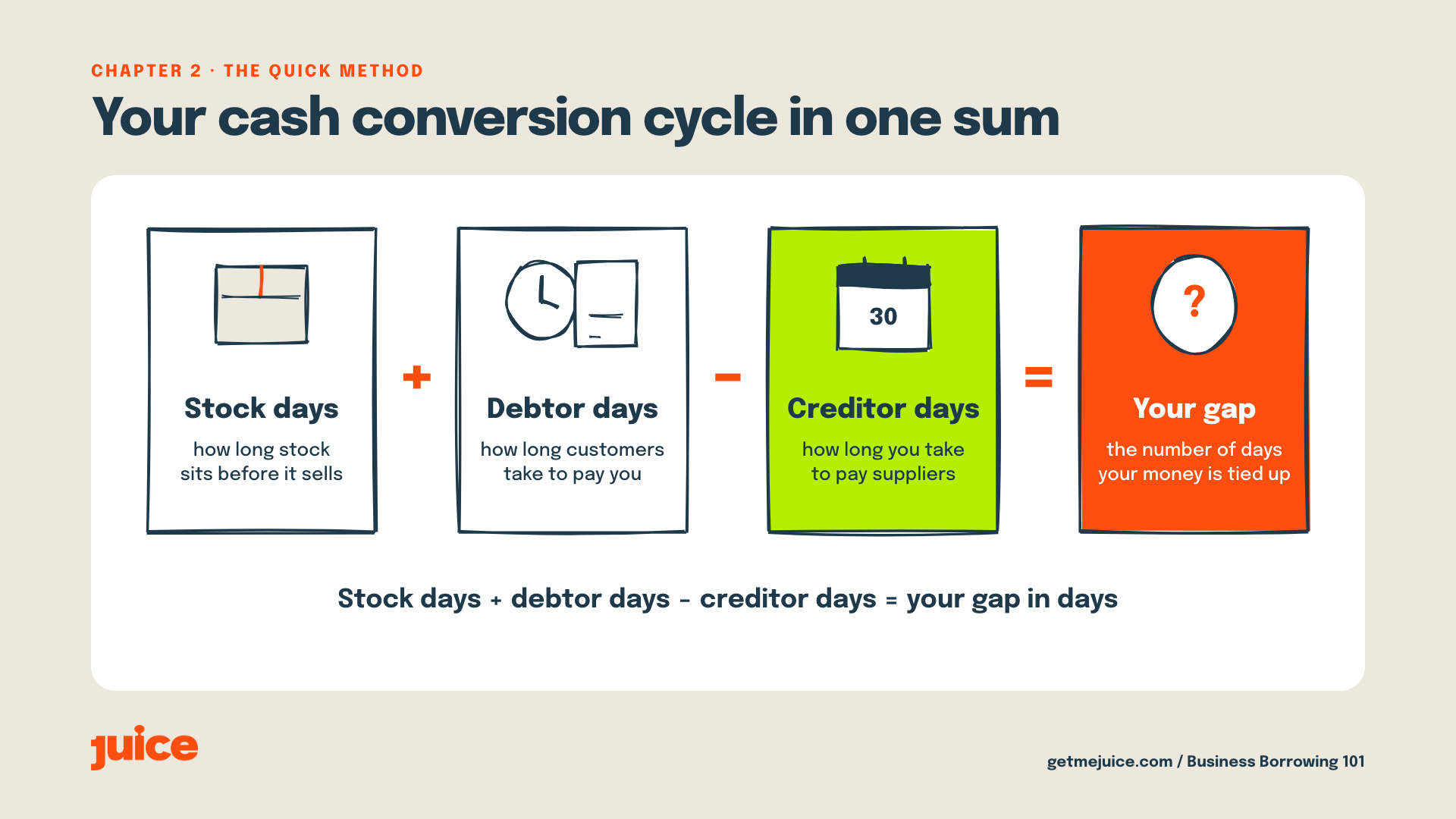
You need 3 figures from your accounts:
- Stock days: how long stock sits before it sells.
- Debtor days: how long customers take to pay you.
- Creditor days: how long you take to pay your suppliers.
Add stock days to debtor days, then take away creditor days. The answer is your gap in days.
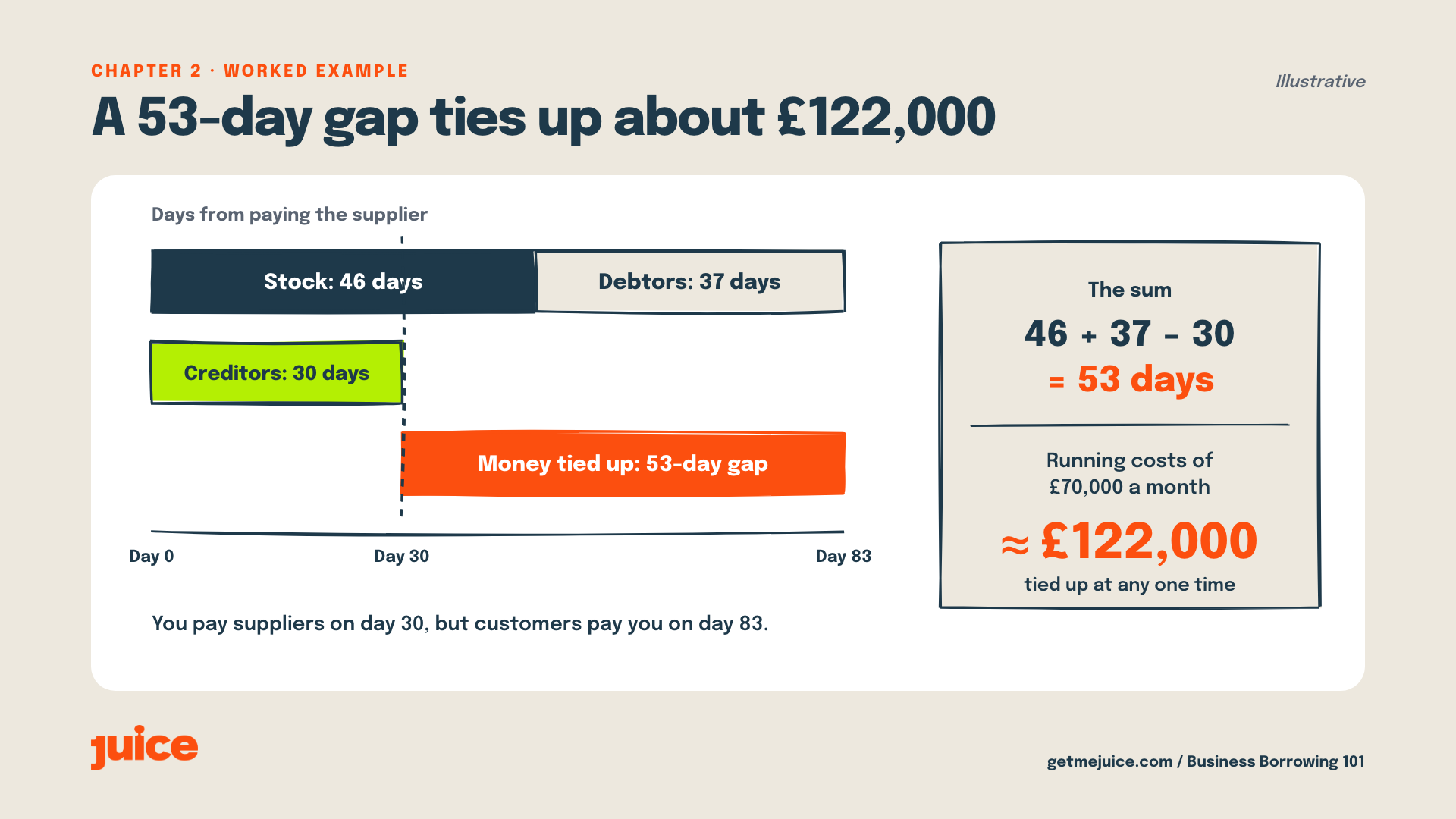
Take a business that holds its stock for 46 days, collects its invoices in 37 days and pays its suppliers in 30 days. That's 46 + 37 − 30, so a gap of 53 days. If the business spends £70,000 a month to run, roughly £122,000 is tied up in that gap at any one time.
The weakness of the quick method is that it averages a whole year. Real cash needs are lumpy, with a VAT bill one month and a big stock order the next, and an average hides both.
The weekly method: a 13-week cash forecast
A 13-week forecast shows you when the money runs low, as well as by how much. To build one:
- Set up 13 weekly columns, starting with today's bank balance.
- Enter money coming in on the dates your customers pay you, which isn't always the date on the invoice.
- Enter money going out on the dates it leaves your account: suppliers, payroll, rent, VAT and tax.
- Look at the closing balance for each week. The lowest point is how much you'd need to cover, and the number of weeks it stays low tells you for how long.
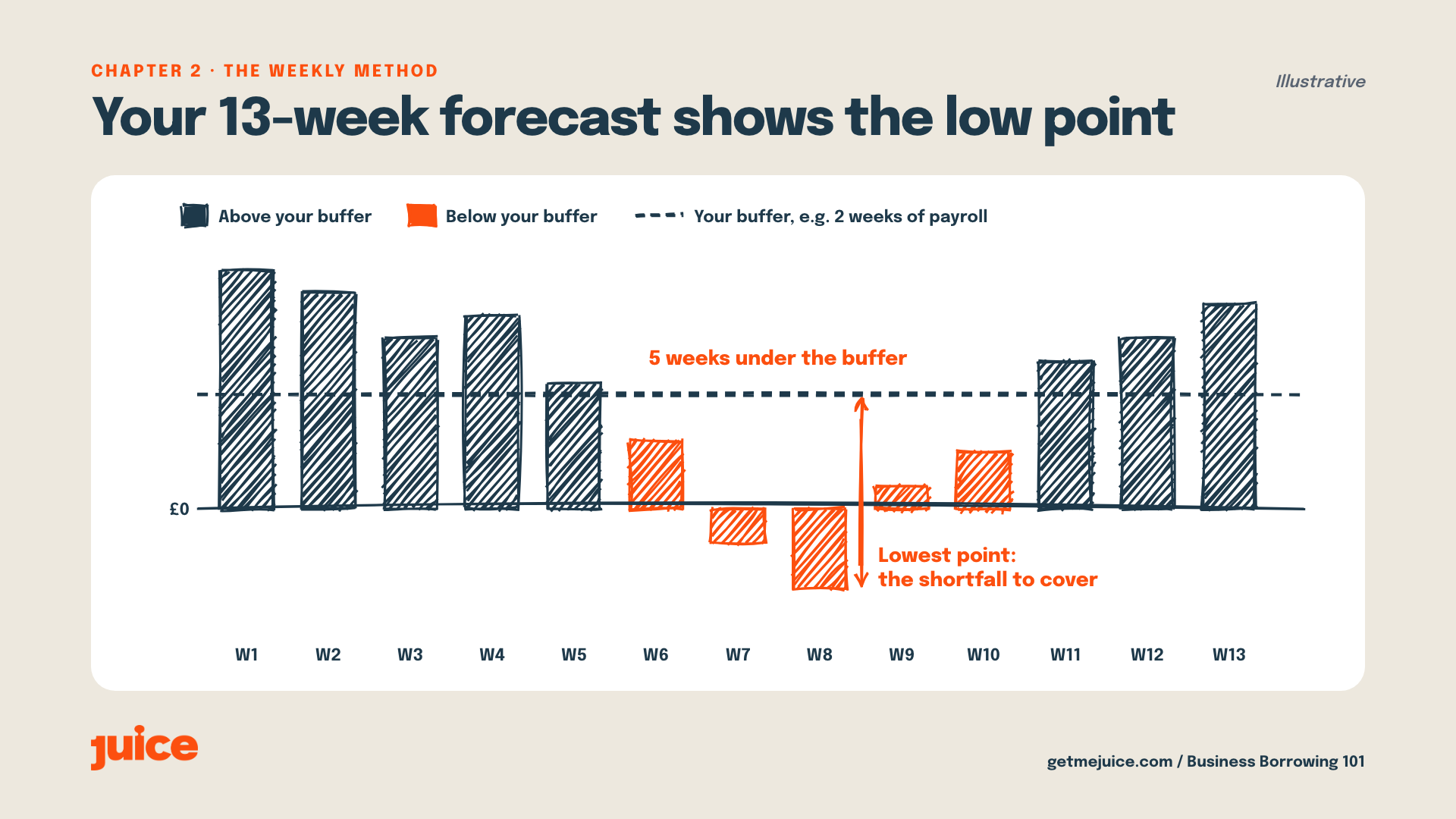
Before you read off the number, decide on a minimum balance you never want to go below, such as 2 weeks of payroll. Measure your shortfall against that buffer and not against £0, because a business that runs its account down to nothing has no room for a late payment or a surprise bill. If you haven't built a forecast before, our article on how to spot a cash flow shortfall before it happens has a rolling version you can follow.
Do you need a lump sum or something you can dip into?
This question decides which type of finance suits you. A one-off need with a fixed cost and a clear end date, such as buying a van or fitting out new premises, points towards a lump sum like a term loan. A need that keeps coming back, such as stock cycles, seasonal peaks or customers who are slow to pay, points towards finance you can draw from, repay and draw again.

If your 13-week forecast shows the same dip every few months, a lump sum means paying for money you only need some of the time. Juice Flex is a continuous line of credit that works alongside your business. Our comparison of revolving credit and term loans and our overview of the types of business finance in the UK explain the options side by side.
Can you shrink the gap instead of borrowing to cover it?
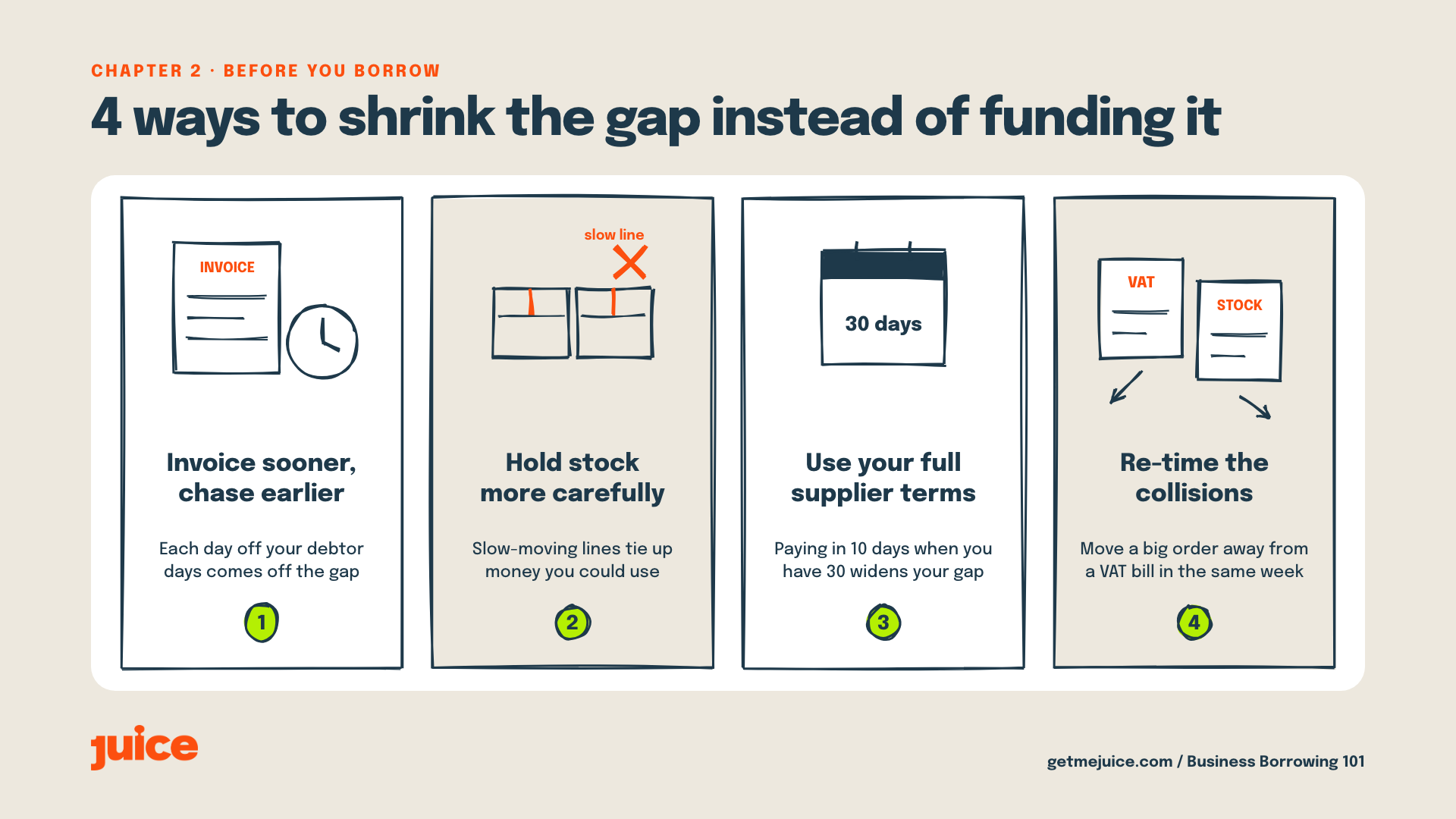
Often you can, and it usually costs less than borrowing. There are 4 places to look:
- Invoice sooner and chase earlier. Every day you take off your debtor days comes off the gap too.
- Hold stock more carefully. Slow-moving lines tie up money that the rest of the business could use.
- Use your full supplier terms. If you have 30 days to pay and you pay in 10, you make your own gap 20 days wider.
- Re-time the collisions. If a big stock order and a VAT bill fall in the same week, moving one of them can halve the shortfall without costing anything.
If your gap comes round at the same time every year, our article on seasonal cash flow covers planning for it, and our practical guide to managing cash flow gaps has more ways to close it.
Should you take more if a lender offers it?
Lenders will sometimes offer you more than you asked for. A bigger number doesn't make it a better deal, because depending on the type of finance you may pay for the extra whether you use it or not. Borrow what your forecast says you need plus your buffer, and stop there. Our article on responsible borrowing has more on choosing an amount.

What should you do once you have your number?
When you know how much you need, for how long and whether the need is one-off or recurring, you're ready to think about how a lender will see your business. Chapter 3 of Business Borrowing 101 covers getting lender-ready, and the business loans in the UK guide compares the main types of finance.
The worked examples in this article are illustrative. This article is general information and isn't financial, legal or tax advice. For advice on your specific situation, speak to your accountant or a qualified adviser.
Juice lends to UK limited companies. All funding is subject to status and lending criteria.