

Why SME Lending Is Still Broken: Notes from Money20/20 Europe
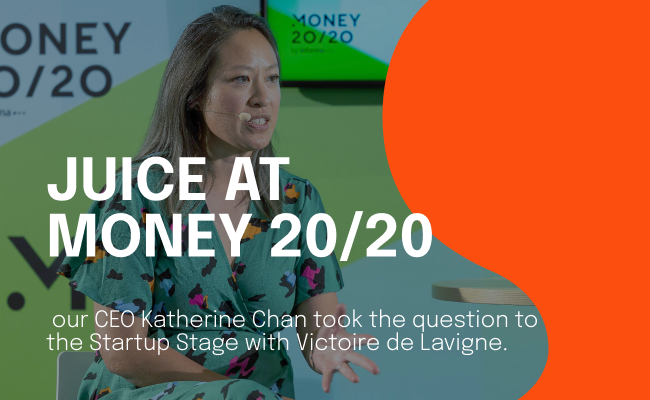
On Wednesday 3 June, our CEO Katherine Chan took the Startup Stage at Money20/20 Europe in Amsterdam. She was in conversation with Victoire de Lavigne from Portage, and the question on the table was a familiar one: why is SME lending still broken?
Katherine has been asking it for years. The data she brought to the panel was uncomfortable enough that the room got quiet a few times. Here is what she shared, and why it matters.

The paradox at the heart of UK SME finance
Katherine opened with a contradiction that anyone working in this market knows but rarely says out loud.
UK SMEs make up 99% of all UK businesses and produce nearly half of all business turnover. And yet the British Business Bank estimates a £22 billion SME funding gap.
The gap is not a shortage of ambition. Katherine's argument, drawn from a Juice whitepaper published earlier this year, is that it is a shortage of clarity. Thousands of founders are walking away from finance not because they cannot get it, but because the system asks them to do too much, too soon, with too little information.
"Thousands of founders aren't walking away because they're unqualified. They're walking away because finance feels like a trap. This is a design failure, and design failures can be fixed."
— Katherine Chan, CEO, Juice Ventures
The scale of the problem
The conversation drew on research Juice published earlier this year. We surveyed 250 UK SME founders and the picture that emerged was one most people in the room recognised.
A majority of founders had abandoned loan applications midway through, often not because they were ineligible but because the process felt too complex or too frightening to see through. Many had never started an application at all. A significant share had signed agreements they did not fully understand. And almost everyone said they would prefer loan terms explained in plain language than in the legal-formal documentation the industry has long defaulted to.
The full picture is in our whitepaper, Blind the Gap: The Financial Literacy Gaps Shaping UK SME Lending.
The pattern Katherine traced across that data was that two parallel failures are happening at once. Founders are exiting the market before the market gets a chance to serve them. Lenders are building products for the founders who already know how to navigate the system, and missing the rest.
Why the system is broken
Katherine spent the middle of the conversation on the why. The breakdown sits on both sides.
On the demand side, debt stigma still shapes how founders see finance. More than half of UK SME owners associate borrowing with shame or failure rather than treating it as a strategic tool. Founders anticipate rejection and protect themselves from it pre-emptively. The ones most comfortable with borrowing are those who grew up around it, were taught to negotiate it, or built networks inside it. Confidence compounds, and so does its absence.
On the supply side, lenders have built products for the financially literate. Terms are opaque and documentation is dense, with eligibility criteria often hidden until rejection arrives. Systemic bias sits underneath all of that, quietly predicting who gets funded along lines of gender, educational background, and geography.
When Victoire brought in the capital markets perspective, the picture sharpened. Even well-capitalised programmes fail when complexity outweighs perceived return. Regulatory friction adds drag. The Mansion House Accords, designed to unlock institutional funding for UK growth businesses, have been slow to materialise.
What "fixed" would look like
The last part of the conversation moved from diagnosis to design. What would a working system look like?
3 principles kept coming back across the panel.
1. Clarity
It means loan terms written in plain language, eligibility published before the application begins, and decisions explained in sentences a founder can use. The founders we surveyed are not asking for a favour. They are asking for the baseline.
2. Control
Founders need products that flex with their cash flow, not fixed-term schedules that demand repayment regardless of what the business is doing that month. Revolving credit lines, draw-when-you-need-it structures, and underwriting models built on real-time financial data rather than stale credit history all sit in this category.
3. Collaboration
Fintechs, banks, policymakers, and community partners need to act as allies. Financial education has to be embedded in the lending journey, not added as a side-of-desk afterthought.
What stuck with us after the panel

The room didn't disagree with the data. That isn't the hard part anymore. The hard part is whether the industry has the appetite to act on it.
Katherine closed with a reminder of the stakes. The £22 billion funding gap is not abstract. It is the cost of growth plans postponed and jobs not created. Every stakeholder in the system, lenders, regulators, investors, and founders, owns part of the fix.
At Juice, we keep coming back to this because the data tells us what the industry has built so far is still not working for too many of the businesses it exists to fund. That is the gap we want to close.
Read the full research: Blind the Gap: The Financial Literacy Gaps Shaping UK SME Lending