


Revolving Credit Facility UK: Complete Guide for SMEs
Part of our Revolving credit facility guide.
Last updated on 10 July 2026.
A revolving credit facility is a flexible form of business borrowing. A lender agrees a credit limit, the business draws funds when it needs them, repays under the agreed facility terms, and can draw again as the repaid amount becomes available. Interest is usually charged on the amount drawn, not the full limit, although other facility fees may apply.
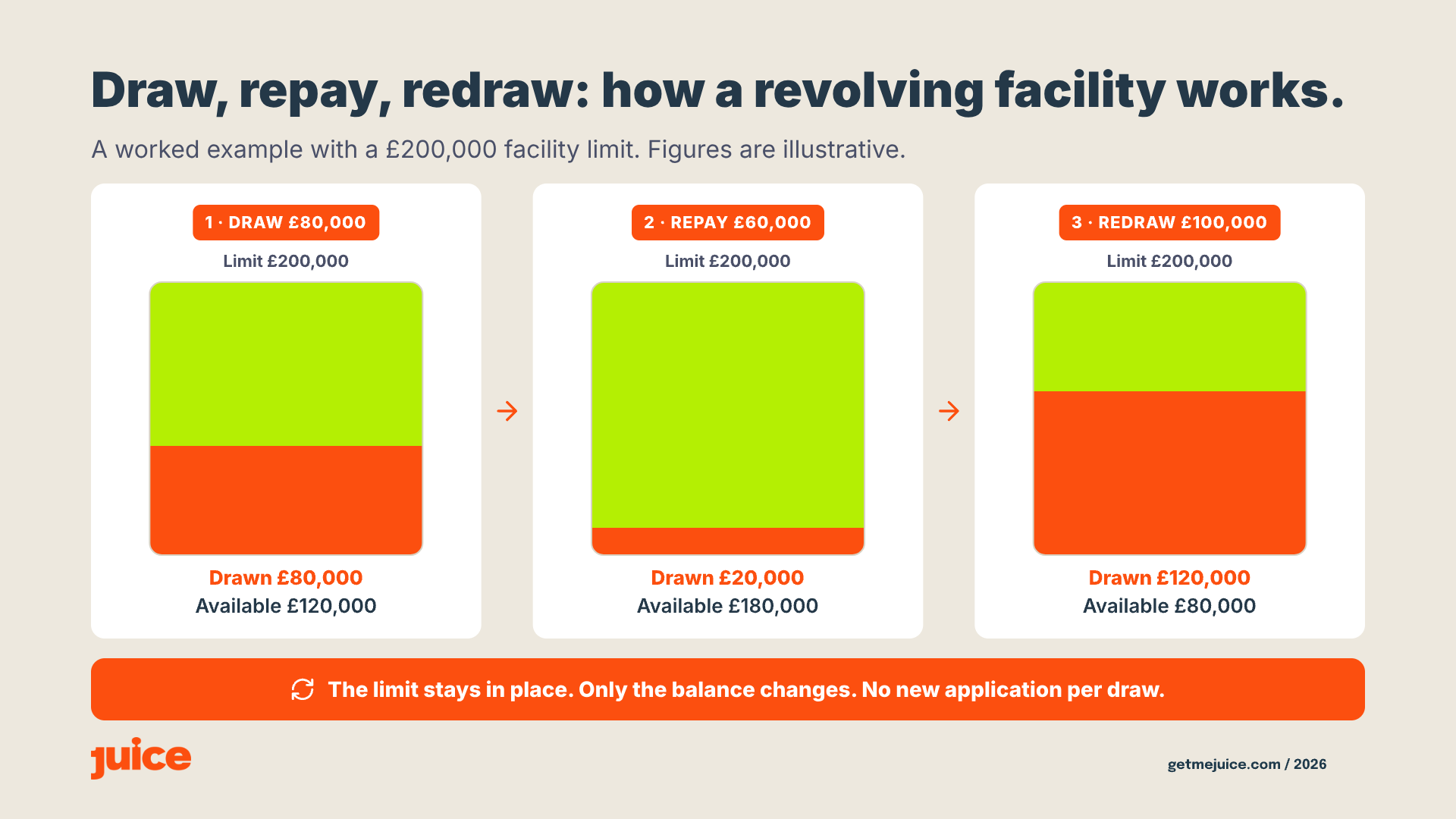
That structure is the key difference from a term loan, which usually pays out one lump sum that you repay over an agreed term. With a revolving facility, borrowing can flex with your working capital cycle. Draw £80,000 from a £200,000 limit and you usually pay interest on the £80,000 drawn, not the full £200,000 limit. Repay £60,000 and your available credit may return to £180,000, subject to the facility terms.
This guide explains how revolving credit facilities work in the UK, what they cost, when they may suit a business and when they may not, and how they compare with overdrafts, term loans and other funding options.
How a Revolving Credit Facility Works in Practice
Imagine you have a £200,000 revolving credit facility. On day one, you draw £80,000 to pay a supplier invoice. You pay interest only on £80,000.
Two weeks later, customer payments arrive. You repay £60,000. Your drawn balance drops to £20,000, and your available credit resets to £180,000. Interest accrues only on the remaining £20,000. The following month, a new order requires £50,000 in stock. You draw again. No new application. No new credit check. The facility is already in place. This draw-repay-redraw cycle is what makes a revolving facility different from a term loan. The facility does not diminish as you repay it. It restores.
Key Terms and Concepts
Facility limit: The maximum amount you can have drawn at any point. Your drawn balance cannot exceed this. Juice Flex offers limits from £50,000 to £1,000,000, subject to status and lending criteria.
Drawn balance: The amount currently outstanding. Interest accrues on this figure only, not on the full facility limit.
Available credit: Facility limit minus drawn balance. This is what you can draw at any time without reapplying.
Interest rate: Applied to the drawn balance on a daily or monthly basis. The lower your drawn balance, the less interest you pay.
Facility term: Different lenders structure facilities differently. Some have a defined annual term with periodic review. Others offer flexible terms. Some require periodic clean-down (a period where the drawn balance is fully repaid). Check the specific terms with each lender.
Covenants: Financial conditions attached to the facility — for example, minimum revenue or maximum leverage ratios. Breaching a covenant can trigger a facility review or mandatory repayment. Read these carefully before signing.
Revolving Credit vs Term Loan: the Core Difference
A term loan provides a fixed sum upfront, repaid over a set period in fixed instalments. The cost is predictable but inflexible. You pay interest on the full outstanding balance from day one, including on capital you have not yet deployed.
A revolving credit facility has agreed repayment terms up to 24 months per draw and the facility itself revolves. You repay each draw on its agreed schedule (with early repayment free) and redraw against your limit as your cash flow allows. Interest accrues only on what you have drawn. For businesses with cyclical or uneven cash flow, this structure typically results in a lower total cost of capital.
When a Revolving Credit Facility Makes Sense
A revolving credit facility is well-suited to:
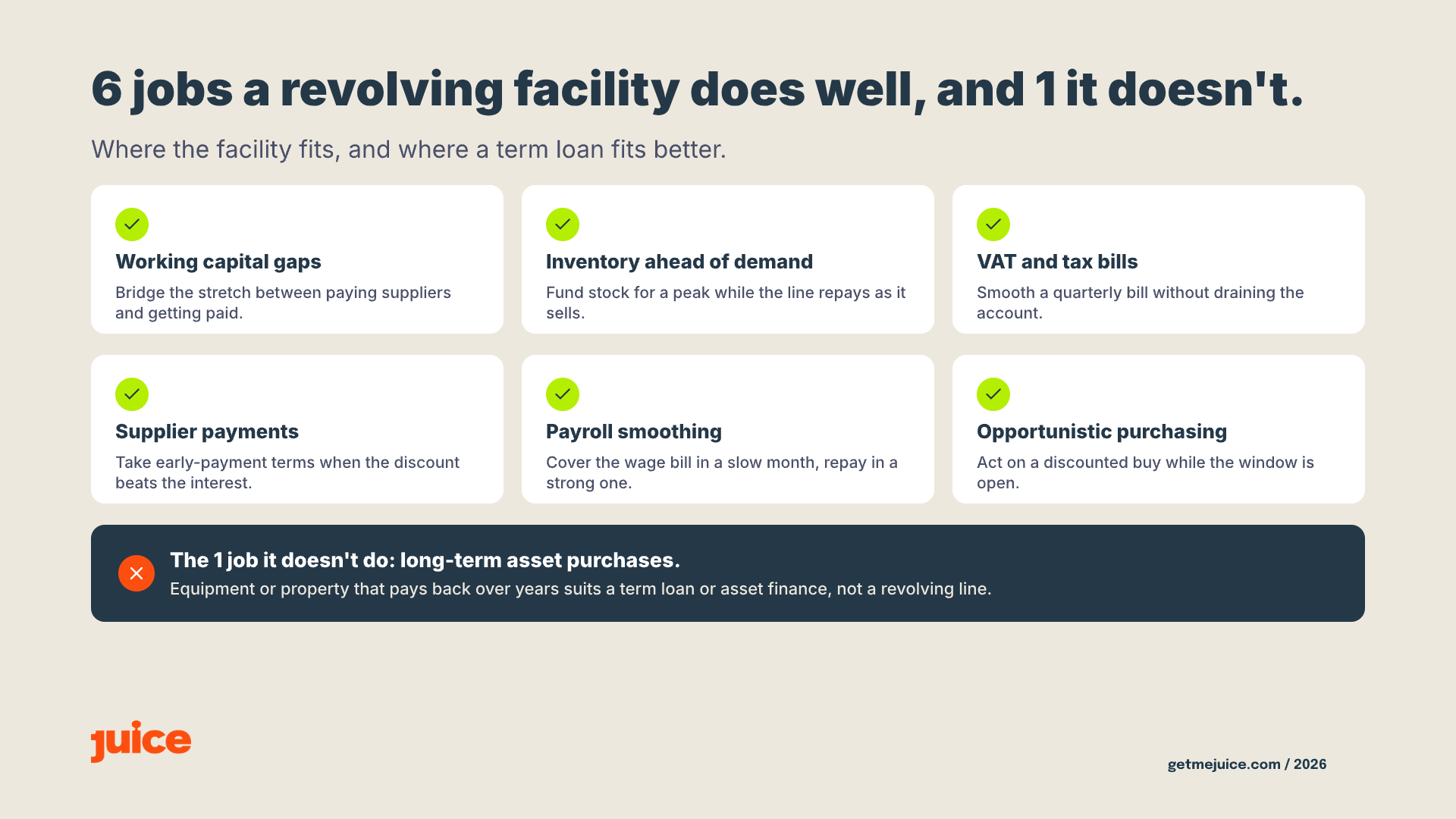
- Working capital management — bridging timing gaps between costs and revenue
- Inventory financing — purchasing stock ahead of sales or peak season
- VAT and tax bills — covering quarterly obligations before they impact operational cash flow
- Supplier payments — paying on time to preserve supplier relationships and early payment terms
- Payroll smoothing — covering payroll in months where revenue is delayed
- Opportunistic purchasing — acting on a bulk discount or short-notice deal without waiting for cash to build
It is less suited to long-term capital expenditure (where a term loan or asset finance may be more appropriate) or for businesses with highly unpredictable revenue that cannot service an ongoing facility.
How Interest Is Calculated
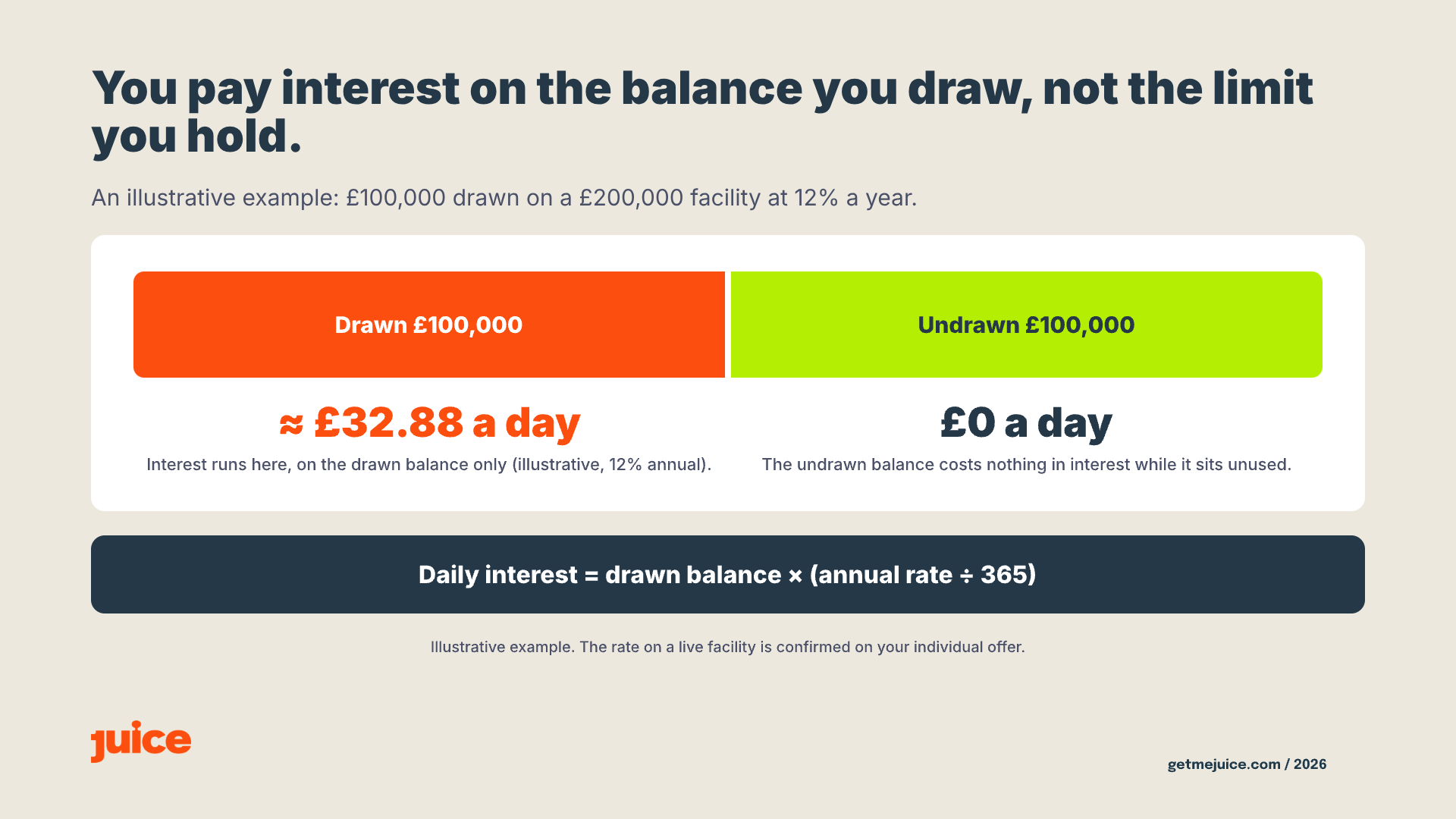
Interest on a revolving credit facility is typically calculated daily on the drawn balance. The formula is straightforward:
Daily interest = Drawn balance × (Annual rate ÷ 365)
If your drawn balance is £100,000 and your annual rate is 12%, your daily interest charge is approximately £32.88. Over a month where your average drawn balance is £100,000, your interest cost is approximately £986.
Repay £40,000 and your daily interest cost drops to approximately £19.73. The relationship between your drawn balance and your interest cost is direct and continuous.
This is an illustrative example. Actual interest rates depend on the lender and your individual lending terms.
Facility Utilisation: What CFOs Need to Know
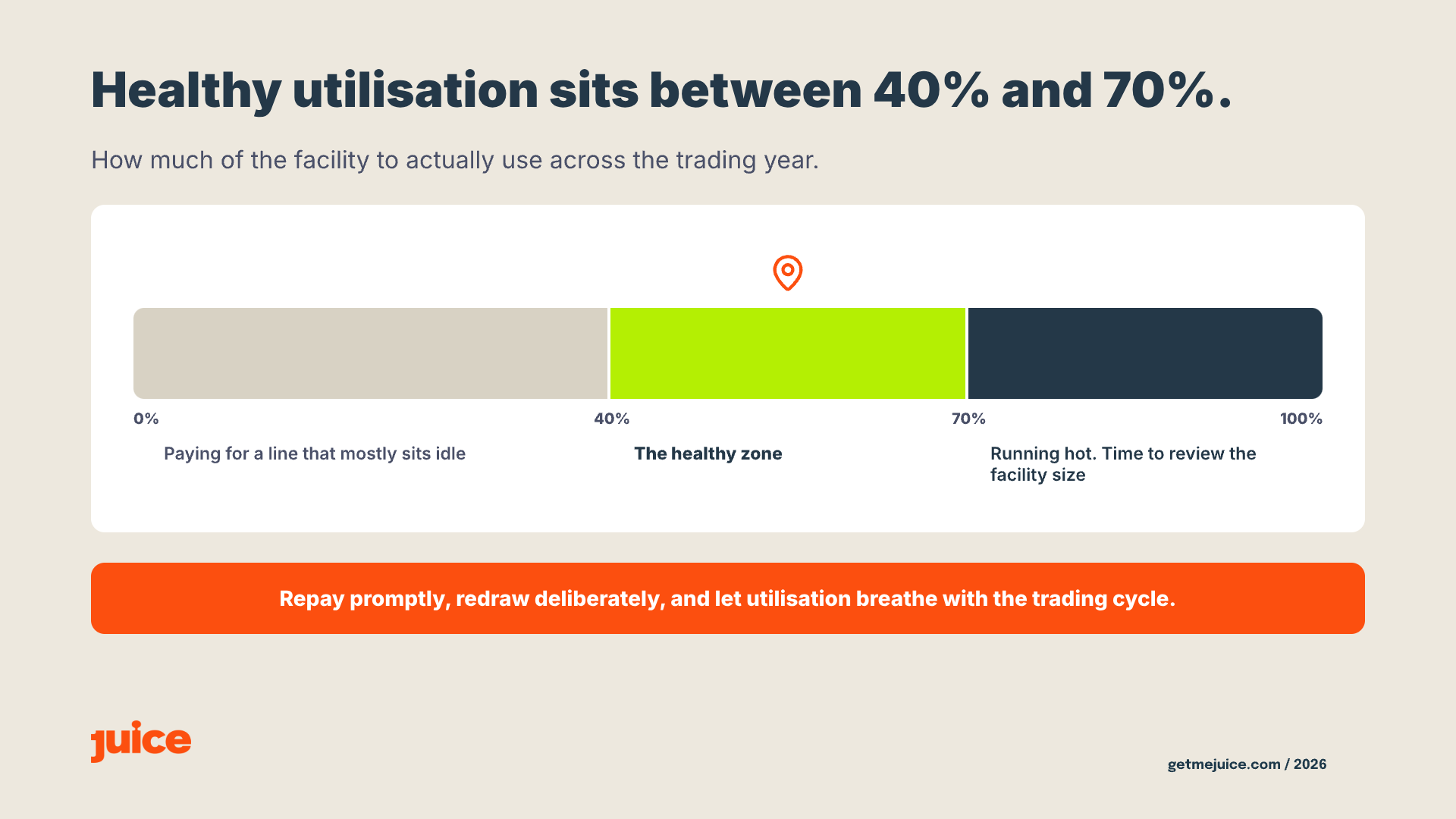
Utilisation is the proportion of your facility limit currently drawn. A facility drawn at 95% of its limit offers almost no buffer for unexpected needs. Healthy utilisation for most businesses is typically 40–70% of the limit, leaving meaningful headroom.
Managing utilisation well means:
- Repaying promptly as revenue lands, rather than holding cash and keeping the facility drawn
- Redrawing only for specific operational needs rather than as a permanent cash buffer
- Monitoring average drawn balance against the limit to understand effective utilisation over time
A well-managed facility stays available when you need it most. A consistently over-utilised facility provides no buffer and may trigger a lender review.
Comparing Revolving Credit Facilities: What to Assess
Not all revolving credit facilities are structured the same way. Before signing, compare:
- Interest rate — and whether it is fixed or variable
- Arrangement fee — typically charged as a percentage of the facility limit at outset
- Commitment or non-utilisation fee — a charge on the undrawn portion of the facility
- Minimum draw amount — some lenders impose a minimum drawdown size
- Drawdown notice period — same-day vs one to two business days
- Covenant package — what financial conditions you must maintain
- Security requirements — vary by facility size and individual lending criteria
- Review frequency — how often the lender reassesses the facility
Total cost per £ drawn is a more useful comparison metric than headline interest rate alone. A facility with a slightly higher rate but no commitment fee may cost less than one with a lower rate and a significant non-utilisation charge — depending on your expected utilisation pattern.
UK Businesses Comparing Revolving Credit
Most UK businesses comparing revolving credit facilities are not choosing funding in isolation. Most compare a few familiar options and ask the same question: will this support cash flow, or add pressure?
Juice Flex: How It Works
Juice Flex is a revolving credit facility for UK SMEs, from £50,000 to £1,000,000. Interest accrues on the drawn balance only. Repayments restore the available limit without reapplication. Each draw has agreed repayment terms up to 24 months, with early repayment always free.
Security requirements vary by facility size; full criteria are confirmed on application. For CFOs evaluating working capital facilities, Juice Flex is designed to flex with the business's cash flow cycle rather than imposing a fixed repayment calendar on top of it.
Subject to status and lending criteria.
Frequently asked questions:
What is a revolving credit facility?
A revolving credit facility gives your business a pre-approved limit that you can draw from, repay on agreed terms, and redraw as often as you need without a new application. Unlike a fixed-term loan, where the funds are gone once spent, the facility is revolving: once repaid, your limit refreshes. That gives you ongoing access to manage inventory, bridge invoice gaps, or act on new opportunities, and you only pay interest on what you use.
What can I use a Juice revolving credit facility for?
You can use Juice funding for most working capital needs, including stock, marketing, supplier payments, and short-term cash flow gaps. We'll always encourage you to fund what works – using your data and our Insights to avoid unnecessary borrowing.
Is a Juice revolving credit facility right for my business?
If you are a UK SME with regular revenue and you're looking for flexible business funding rather than a long, complex bank process, Juice may be a good fit. We'll always be upfront if we're not the right option, giving you an explanation and a path forward. Get in contact today or apply on our platform to see if you are eligible.
What type of funding does Juice offer?
Juice offers Smart Growth Capital™ – a combination of flexible funding and real-time insights.
Our flagship product is Juice Flex, a revolving credit facility (£50K–£1M) that provides UK SMEs with an on-demand line of credit, allowing you to draw down funds when you need them and pay interest only on what you use.
To help you borrow smarter, it is powered by Juice Insights, our AI growth copilot. By analysing your real-time data, Juice Insights provides cash runway forecasts and financial health scores, ensuring you have the clarity to draw from your Flex facility at the most strategic moments for working capital, inventory, marketing, or seasonal scaling.
What type of business loans does Juice offer?
Juice offers Smart Growth Capital™ – a combination of flexible funding and real-time insights. Our flagship product is Juice Flex, a revolving credit facility (£50K–£1M) that provides UK SMEs with an on-demand line of credit, allowing you to draw down funds instantly and pay interest only on what you use. To help you borrow smarter, it is powered by Juice Insights, our AI growth copilot. By analysing your real-time data, Juice Insights provides cash runway forecasts and financial health scores, ensuring you have the clarity to draw from your Flex facility at the most strategic moments for working capital, inventory, marketing, or seasonal scaling.
Key Takeaways
- A revolving credit facility lets you draw, repay, and draw again up to an agreed limit — interest accrues on the drawn balance only
- It is among the most cost-efficient structures for recurring working capital needs, because you only pay for what you use
- Each draw has agreed repayment terms up to 24 months, and early repayment is free
- Utilisation discipline and covenant management are the two key operational variables for CFOs
- Comparing total cost per £ drawn — not just the headline rate — is the right metric for evaluating facilities
Related resources
- Working capital loans UK
- Business overdraft vs revolving credit
- Term loan vs revolving credit
- How Juice Flex works: a facility that never expires